
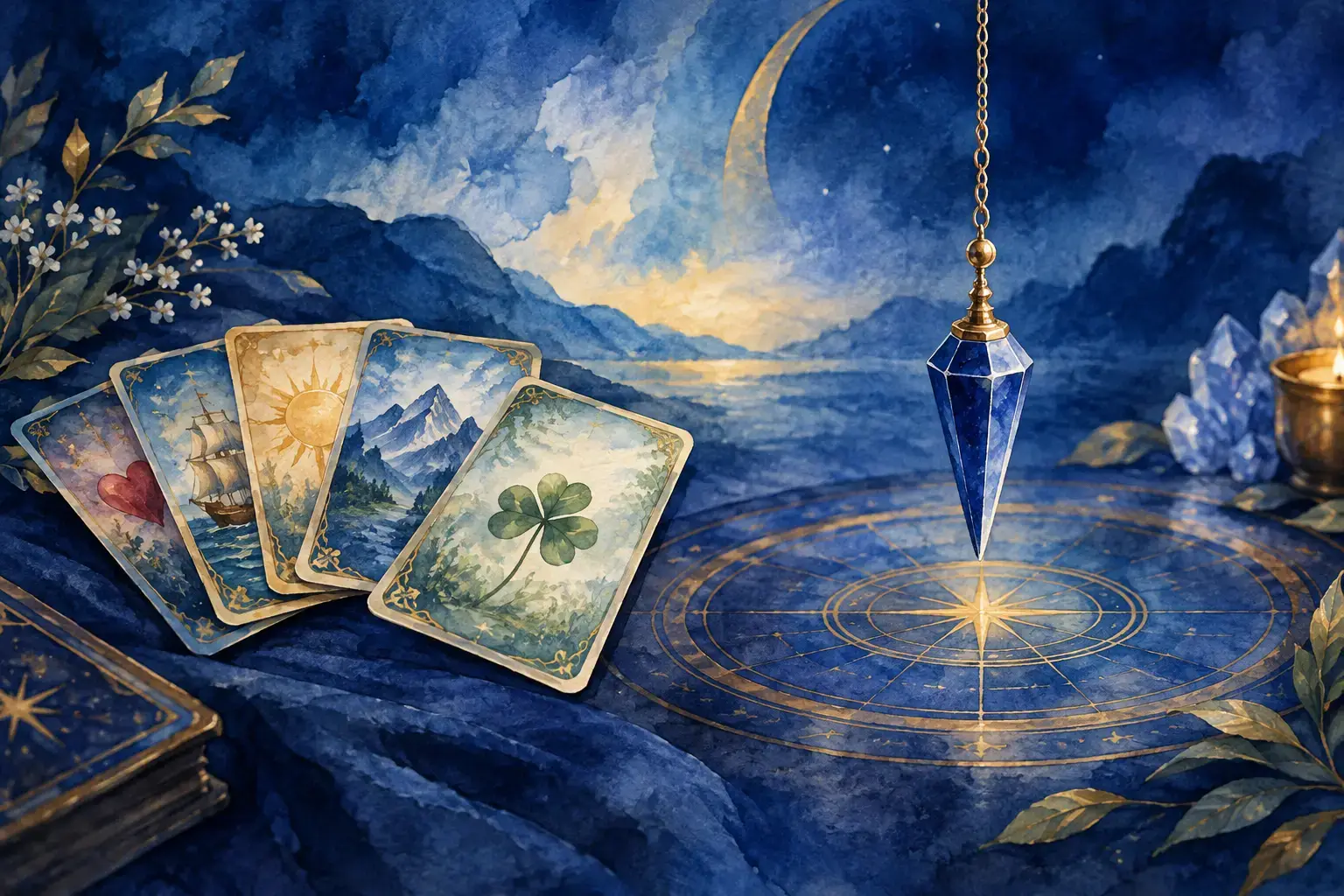
A question can feel too layered for a simple yes or no, yet too immediate to sit with for weeks. That is where Lenormand versus pendulum guidance becomes a meaningful choice. Both practices can help you pause, tune into your intuition and see a situation from a fresh angle, but they do so in very different ways.
A pendulum is often best when you need focused confirmation around a clearly framed question. Lenormand is better suited to the fuller story: the people, patterns, influences and likely direction surrounding an issue. Neither method removes your personal agency or offers a fixed promise about the future. Used thoughtfully, each can offer a calmer place from which to make your next decision.
What pendulum guidance is designed to do
Pendulum guidance uses a weighted object, often suspended from a chain, thread or cord. The practitioner establishes signals for yes, no and sometimes uncertain or not now, then asks a question while observing the pendulum's movement.
Its appeal is its simplicity. When your thoughts are circling around one practical point, a pendulum can feel direct and grounding. You might ask, “Would it support my wellbeing to have this conversation this week?” or “Is this opportunity worth researching further?” The aim is not to hand your choices over to the pendulum. It is to notice the response, your own reaction to it, and the feelings that arise underneath the question.
The quality of the question matters greatly. A vague question tends to produce a vague experience. “Will my life get better?” contains too many moving parts, while “Would taking a short break before I respond help me communicate more clearly?” is specific, present-focused and within your influence.
When a pendulum can feel helpful
Pendulum work often suits a moment of mental noise. You may already know the options but feel caught in overthinking, second-guessing or emotional fatigue. A short, centred practice can create a pause between impulse and action.
It can also be useful for checking in with your current readiness. Rather than asking whether a relationship will last forever, you could ask whether you are ready to raise a particular concern honestly. This keeps the focus on your awareness and choices, rather than trying to force certainty from an uncertain situation.
There are limits. Because pendulum guidance is generally framed around concise answers, it may not reveal why an obstacle exists, what another person is feeling, or what context you have missed. If the answer brings more questions than clarity, a broader method may serve you better.
How Lenormand brings a situation into focus
Lenormand is a card-reading system with a distinctive visual language. Each card carries a recognisable symbol, such as the Rider, Heart, Crossroads, Clouds, Key or Anchor. The meaning comes not only from an individual card, but also from the combinations, positions and sequence created in a spread.
Where a pendulum may offer a clear directional response, Lenormand maps the terrain around your question. A reading can explore communication, timing, emotional undercurrents, practical pressures, choices and potential developments. It is often wonderfully concrete, especially when life is asking you to look at the whole picture rather than one isolated answer.
For example, a person wondering about a career move may not only want to know whether to apply. They may need insight into confidence, workplace dynamics, financial security, other options and the actions that could improve their position. A Lenormand spread creates room for these connected threads to be considered together.
The strength of symbols and combinations
Lenormand is particularly useful for people who appreciate detail. A single card offers a theme, but paired cards refine that theme. The Crossroads beside the Heart may suggest an emotional choice. The Clouds near the Letter may point to unclear communication. The Anchor alongside the Key can encourage attention to a stabilising solution.
These symbols are prompts for reflection, not instructions carved in stone. A skilled reader considers the question, the card placement and the relationship between symbols before sharing an interpretation. The most valuable reading does not simply tell you what you want to hear. It helps you recognise what is already asking for your attention.
Lenormand versus pendulum guidance for common questions
The best method depends on what you genuinely need from the session. If your question is narrow and immediate, pendulum guidance may be the more natural fit. It can support a focused check-in when you have defined the choices and want to settle your mind before taking a sensible next step.
If the situation is emotionally complex or involves several people, Lenormand may offer more depth. It can be helpful for relationship patterns, career crossroads, recurring challenges or periods when you cannot yet see the complete story. A spread gives the conversation space to unfold rather than compressing it into an answer that may be too small for the question.
Consider these differences:
- Choose a pendulum for clear, contained questions that can be approached with yes, no or not yet.
- Choose Lenormand when you want context, connections and a wider perspective on what may be influencing events.
- Use either method when you are open to reflection, rather than seeking a guarantee or permission to ignore your own judgement.
- Step back from both if you feel highly distressed, pressured or unable to make a decision without repeated checking.
Repeatedly asking the same question can make any divination practice feel more confusing. If you receive guidance that unsettles you, allow time to process it. Journal your response, speak with someone you trust, or return to the practical facts of the situation. Clarity often grows through a combination of intuition, conversation and grounded action.
A gentle way to prepare for either reading
You do not need an elaborate ritual to begin. Find a quiet moment, put your mobile aside and take a few slow breaths. Name what is happening without judging yourself: “I feel torn about this change,” or “I am worried about what I cannot control.” That honesty gives your question a stronger foundation.
With a pendulum, phrase one question at a time and avoid stacking multiple outcomes into the same sentence. With Lenormand, offer enough context for the question to be meaningful, while staying open to what the cards may highlight. You might ask, “What do I need to understand about this relationship dynamic?” rather than demanding a prediction about another person's every move.
Afterward, write down the guidance and the action it suggests. A reading is most useful when it helps you choose a conversation, boundary, research step or period of rest that supports your wellbeing. You remain the person living your life and making the choices that shape it.
Receiving guidance with care and confidence
Both Lenormand and pendulum work can be deeply personal. You may be drawn to the quiet certainty of a pendulum one day, then need the rich symbolic perspective of Lenormand the next. There is no need to choose one method forever.
If you would prefer support from a real person, a compassionate reader can help you frame the question and make sense of the themes that emerge. Soul 2 Path offers the flexibility to connect in the way that feels comfortable for you, whether that is a phone reading, a booked session or private online chat.
Let the method serve the moment. Ask an honest question, listen without fear, and take only the next grounded step that feels aligned with your values. That is often where guidance becomes genuinely useful.
