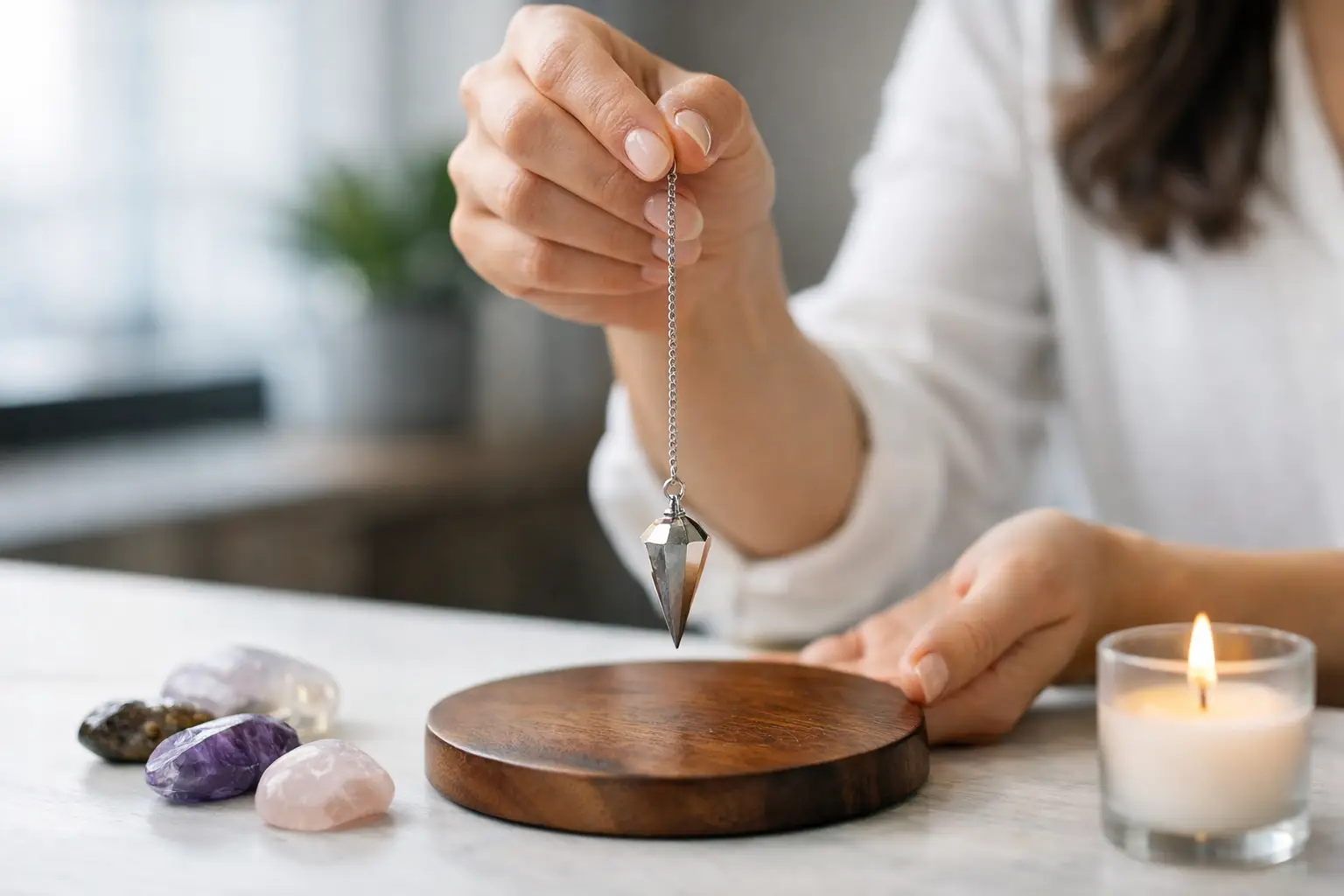
When your mind is noisy and every option feels emotionally loaded, a pendulum can offer a surprisingly clear starting point. If you’ve been wondering how to use a pendulum, the real goal is not to hand your power over to a tool – it’s to create a calm, focused way to hear your own intuition more clearly.
A pendulum reading is simple in theory. You hold a weighted object on a chain or cord, ask a question, and observe how it moves. What makes it meaningful is the energy you bring to it. Your state of mind, the way you phrase your question, and your willingness to stay open all shape the experience.
What a pendulum is really doing
A pendulum is often used as a spiritual guidance tool to help you access intuitive information. Some people see it as communication with their higher self, spirit guides, or universal energy. Others view it as a subtle physical response to unconscious knowing. Both perspectives can sit comfortably together.
What matters most is this: a pendulum is best used for clarity, not control. It can help you check in with your intuition, sense energetic alignment, and bring structure to moments when you feel uncertain. It is not a replacement for practical judgement, medical advice, or major legal or financial expertise.
That balance matters. Used well, a pendulum can support decision-making. Used poorly, it can become a way to seek constant reassurance when what you really need is grounding.
How to use a pendulum for the first time
If you are learning how to use a pendulum for the first time, start by keeping the process simple. You do not need a perfect ritual or rare crystal pendulum to begin. A dedicated pendulum is lovely, but any weighted object suspended on a fine chain can work if you treat it with care and intention.
Before your first session, choose a quiet space where you will not be interrupted. Sit comfortably with both feet on the floor or at a table where your arm can rest naturally. A calm body usually leads to a clearer reading.
It also helps to clear your energy first. You might take a few slow breaths, say a short prayer, set an intention, or spend a minute in silence. The point is to step out of mental chatter and into presence.
Cleanse and set your intention
Many people like to energetically cleanse their pendulum before use. You can do that in a way that feels natural to you – with breath, moonlight, visualisation, sound, or by simply holding it and stating that only clear and supportive guidance is welcome.
Then set a direct intention. Something simple works well: I ask for honest guidance for my highest good. This creates an energetic boundary and helps you approach the reading with respect rather than urgency.
Establish your yes, no and unclear responses
Before asking anything meaningful, you need to learn your pendulum’s movements. Hold the chain between your thumb and forefinger, allowing the pendulum to hang freely. Keep your hand steady but relaxed.
Ask, Show me yes. Wait and watch. It may move in a circle, swing side to side, or move forwards and backwards. Then ask, Show me no. After that, ask for maybe or unclear. For some people, the movements are immediately obvious. For others, they become clearer with practice.
Do not assume that one direction means the same thing for everyone. Your pendulum’s language is personal. The calibration step is what turns random movement into readable guidance.
Ask better questions, get clearer answers
One of the biggest reasons people feel confused by a pendulum is not the tool itself – it’s the question. Pendulums work best with clear, closed questions that can be answered with yes, no, or not now.
Instead of asking, What should I do with my relationship, try asking, Is this relationship currently aligned with my highest good? Instead of, Will I be happy in this job, try, Is accepting this role likely to support me positively at this time?
Good pendulum questions are specific, present-focused, and emotionally steady. If your question is tangled in fear, the reading can feel muddy. If you are desperate for one answer, you may also influence the outcome without realising it.
That is why timing matters. If you are highly upset, angry, or panicked, pause first. A pendulum is most helpful when you use it from a centred place.
What to do during a pendulum session
Once you have calibrated the pendulum, begin with a simple test question that you already know the answer to. This builds trust in the process. Ask something like, Is my name Sarah, or, Do I live in Australia, and observe the response.
When you feel ready, move to your real question. Ask one question at a time and keep your wording consistent. If you keep changing the phrasing, it becomes harder to tell whether the response is shifting or whether the question itself has changed.
Stay still and give the pendulum a moment. Some responses are immediate. Others take time to build momentum. Trying to force movement usually creates more confusion, not more accuracy.
It can also help to write your questions and responses in a journal. Over time, patterns emerge. You may notice that your clearest readings happen in the morning, after meditation, or when you ask fewer questions. This kind of reflection deepens confidence because it is grounded in experience, not guesswork.
When the pendulum feels wrong or inconsistent
Not every session will feel sharp. Sometimes the movement is faint, contradictory, or oddly flat. That does not always mean you are doing something wrong. It may simply mean the timing is off, your energy is scattered, or the question is not suitable for pendulum work.
A few common issues can affect accuracy. Fatigue makes it harder to focus. Emotionally charged questions can lead to attachment. Repeating the same question again and again often creates mixed signals because the energy behind it becomes anxious.
If the pendulum feels off, stop and reset. Cleanse it again, take a break, or come back another day. You can also ask, Is this the right time to ask this question? That alone can save a lot of frustration.
There are also situations where a pendulum should not be your main guide. Health emergencies, serious mental distress, and major legal or financial decisions need practical support first. Spiritual tools can complement grounded action, but they should not replace it.
How to build trust in your own guidance
Learning how to use a pendulum is partly about technique and partly about self-trust. The pendulum can reflect your intuition, but if you dismiss every answer or cling to every movement, the relationship becomes unstable.
A healthier approach is to treat each reading as one source of insight. Let it inform your reflection rather than dictate your life. If a response feels surprising, sit with it. Ask yourself what it brings up emotionally. Often, the deeper value is not only the answer but the self-awareness that follows.
Many people find that combining pendulum work with meditation, journalling, tarot, or a professional psychic reading gives them a fuller picture. If you are at a crossroads and want more personalised support, tools like pendulums can be a helpful first step, while a live reading can add depth, validation, and context.
At Soul 2 Path, that blend of intuitive support and practical clarity is at the heart of spiritual guidance. Some moments call for quiet self-connection. Others call for speaking with someone who can help you see the bigger picture.
A simple practice to start today
If you want to begin without overthinking it, keep your first session short. Sit somewhere quiet, take five slow breaths, and hold your pendulum with a clear intention. Ask it to show you yes, no, and unclear. Then ask one gentle question such as, Is it in my best interest to rest today, or, Am I ready to move forward with this plan now?
That kind of question is easier to read than one loaded with fear about the future. It also helps you build confidence gradually. Small, grounded questions often create the strongest foundation for accurate work.
Your pendulum does not need you to be perfect. It asks you to be present, honest, and willing to listen. The more calmly you approach it, the more likely it is to become a steady companion for clarity when life feels uncertain.
If a pendulum reading gives you a pause, a sense of relief, or a nudge towards what you already knew deep down, that is often where the real guidance begins.