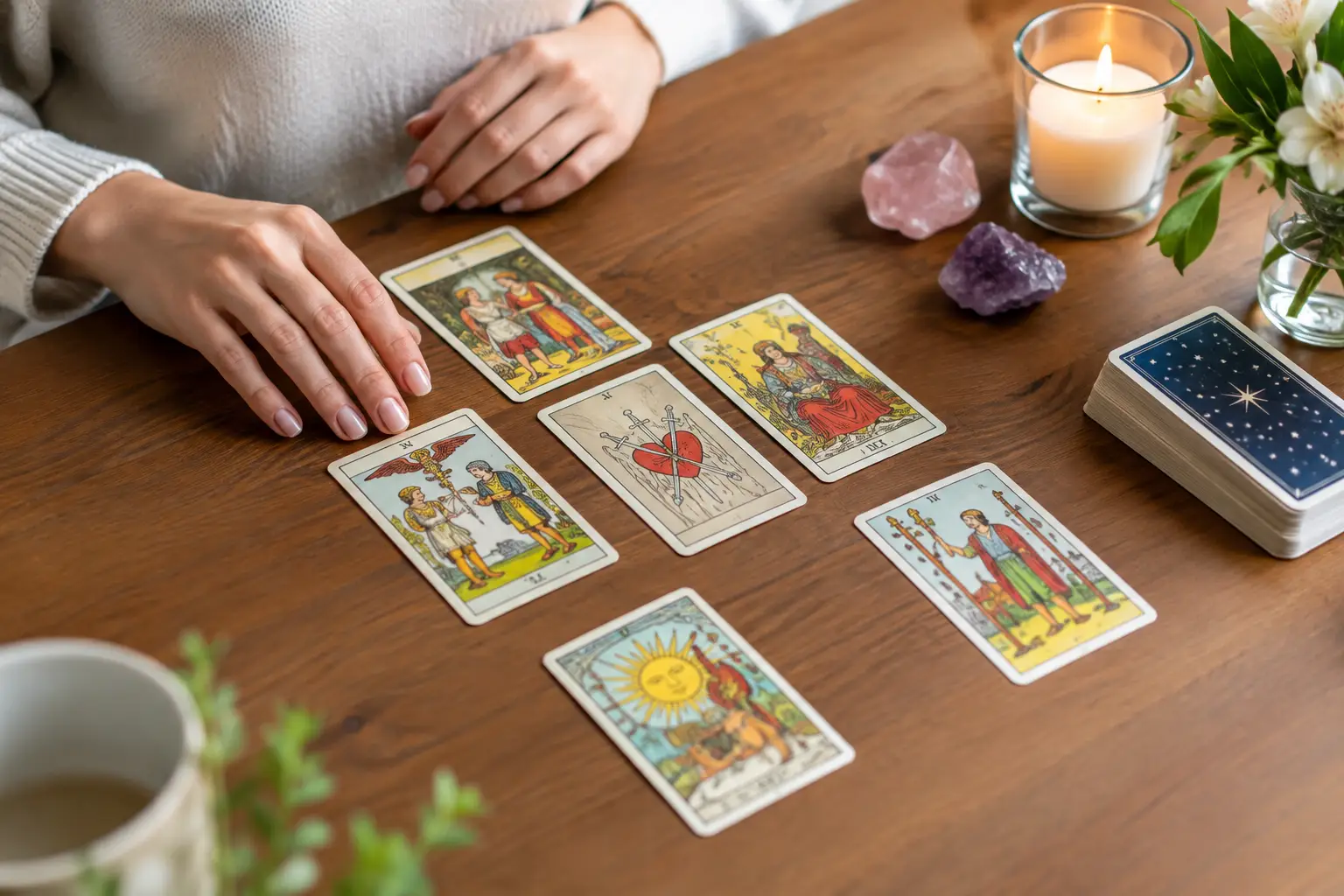
A three-card pull can feel intensely personal when someone’s mixed signals have left you checking your mobile, replaying a conversation, or wondering whether to stay. Relationship tarot spread meanings offer a structured way to sit with those feelings. Rather than handing down a fixed verdict on love, a spread can reveal the energy, needs, patterns and choices asking for your attention.
Tarot works best as reflective guidance. The cards can put language to what you sense but have not yet named, helping you move towards a conversation, boundary or decision with more self-trust. They do not remove another person’s free will, and they cannot replace practical support where a relationship feels unsafe or harmful.
How relationship tarot spread meanings work
A tarot card does not have one permanent meaning in every reading. Its message changes according to the question, the card position, the surrounding cards and your own circumstances. The Three of Swords, for example, may point to heartbreak in a position about the past. In a position about what needs healing, it can suggest that unspoken pain deserves gentle acknowledgement.
This is why position matters as much as the card itself. A relationship spread is a map: each place on that map asks the card to speak about one part of the connection. When you read the cards together, you gain a fuller picture than you would from searching a single card meaning online.
It also helps to ask open questions. “What is the current energy between us?” or “What do I need to understand before I make contact?” invites insight. Questions that try to force certainty, such as “Will they come back by Friday?”, often narrow the reading until it becomes more about anxiety than guidance.
A simple three-card relationship spread
For a new connection, an established partnership, a friendship that feels complicated, or a situation that is still unfolding, three cards are often enough. They keep the message clear and leave room for your intuition.
The first card represents you and your current emotional position. It may show what you hope for, what you fear, or what you are bringing into the relationship. The second card represents the other person’s visible energy or the role they appear to be playing in the dynamic. It is not a claim to read their private thoughts as fact. Instead, treat it as a prompt to notice behaviour, communication and the energy you are experiencing from them.
The third card shows the connection itself or the most helpful next focus. It may reveal a shared strength, a recurring challenge, or an area that needs honest attention. If the card is the Temperance, for instance, it may point to patience, emotional balance and meeting each other halfway. If it is the Five of Wands, it may reflect friction, competing needs or conversations where nobody feels heard.
This spread is especially useful when you feel overwhelmed. It brings the reading back to what you can understand and influence: your own position, the dynamic in front of you, and your next aligned step.
Reading the cards as a conversation
Avoid reading each card in isolation. A Queen of Cups beside the Eight of Swords may suggest deep feeling held back by worry or self-protection. The same Queen of Cups beside the Ace of Cups can speak more easily of emotional openness and a fresh chance to connect.
Notice whether the spread contains many Major Arcana cards. These cards, such as The Lovers, The Tower and The Star, can indicate that the relationship is touching a significant life lesson or personal turning point. That does not automatically mean the connection is destined to last. It may mean it is changing how you understand love, trust, self-worth or choice.
Common relationship tarot spread meanings
Some cards appear regularly in readings about love because relationships ask us to balance closeness with independence, hope with discernment, and passion with communication. Their meaning always depends on the question, but a few themes are worth knowing.
The Lovers is often associated with attraction and partnership, yet it is also a card of values and conscious choice. In a relationship reading, it can ask whether both people are choosing the connection with honesty and care. It may be less about a perfect match and more about whether the relationship reflects what matters most to you.
Two of Cups can signal mutual feeling, emotional reciprocity and a willingness to meet as equals. It is encouraging in a connection where effort is being shared. However, one positive card should not outweigh a pattern of inconsistency, disrespect or avoidance in real life.
The Devil can bring up attachment, jealousy, secrecy, power imbalances or a bond that is hard to step away from. It is not a label for either person. Its deeper invitation is to ask where fear, desire or old conditioning may be taking the lead, and what freedom would look like now.
The Tower can feel alarming, particularly if you are already worried about a breakup. Often, it points to a truth that can no longer be avoided or a structure that needs to change. A difficult conversation may be disruptive, but it can also clear space for greater honesty. Whether the relationship continues depends on what both people are willing to face and rebuild.
The Star brings hope, healing and a return to emotional clarity. In the aftermath of disappointment, it may suggest that your heart is recovering. In an ongoing relationship, it can show that gentleness and renewed faith are possible, provided hope is supported by consistent action.
Court cards can describe a person, but they may also show the energy needed. A King of Swords could reflect someone who communicates with logic and restraint, or it could advise you to seek clarity and hold a firm boundary. A Page of Cups may point to a tender message, emotional curiosity or the need to speak from a more open-hearted place.
When difficult cards appear
A challenging card is not a punishment and does not mean you have failed at love. Tarot can bring forward what is uncomfortable precisely because avoidance rarely creates clarity. If the Five of Pentacles appears, consider feelings of exclusion, loneliness or unequal support. If the Seven of Swords appears, look carefully at what is not being said, including any ways you may be avoiding your own truth.
Reversed cards can add another layer, but they do not have to mean the opposite of an upright card. A reversed Hermit might suggest isolation that has gone on too long, an inner answer you are resisting, or a need to stop withdrawing from a necessary conversation. Choose a reading style that feels consistent rather than treating reversals as automatic bad news.
The most useful response to a difficult spread is a grounded question: “What is within my control?” You might be guided to slow down, clarify an expectation, honour a boundary, seek support, or let actions speak louder than promises.
Questions that bring clearer guidance
Relationship readings become more meaningful when they centre your agency. Before shuffling, take a breath and name the area where you need support. If you are deciding whether to continue a relationship, ask what you need to know about its current health and what choice supports your wellbeing. If communication has cooled, ask what pattern is affecting connection and how you can approach it with dignity.
It can be tempting to keep pulling cards until you find the answer you want. Usually, that creates more confusion. Set a limit before you begin, write down the cards and your first impressions, then give the message time to settle. The insight may arrive later while you are making a cuppa, walking outside or noticing the next interaction more clearly.
For a more detailed situation, a five-card spread can be helpful. Use positions for your energy, their outward energy, the shared dynamic, the challenge and your wisest next step. This offers depth without turning the reading into a maze of predictions.
Let tarot support real-world clarity
Tarot is most supportive when it helps you recognise what is already happening. If a reading suggests openness, consider whether there is evidence of mutual respect and follow-through. If it highlights distance, ask whether you have communicated your needs and whether the other person has the capacity to meet them.
Where there is coercion, manipulation, violence or fear, prioritise your safety and seek appropriate practical support. No card asks you to remain in a situation that harms you. Spiritual guidance should strengthen your connection to your own voice, not make you doubt it.
If you would like a private, compassionate space to explore a relationship question, a Soul 2 Path reader can help you unpack the cards and the emotions around them in a way that feels personal and grounded. The clearest relationship tarot spread meanings are not always about whether someone will choose you. Often, they gently bring you back to the more powerful question: what choice honours your heart, your boundaries and the love you are ready to receive?