A Lenormand spread can feel strangely precise from the very first pull. Where tarot often opens an emotional landscape, lenormand card meanings tend to get straight to the point – the message is often about what is happening, what is influencing it, and what may come next. For anyone seeking clarity around love, timing, work, or a difficult decision, that directness is exactly what makes Lenormand so useful.
If you are new to this system, the first thing to know is that Lenormand is a practical divination tool built around symbols rather than long spiritual archetypes. The cards are read in relation to each other, so a single card matters, but the real story appears when two or more cards sit together. That means accuracy often comes from context, not memorising a rigid definition.
What Lenormand is really telling you
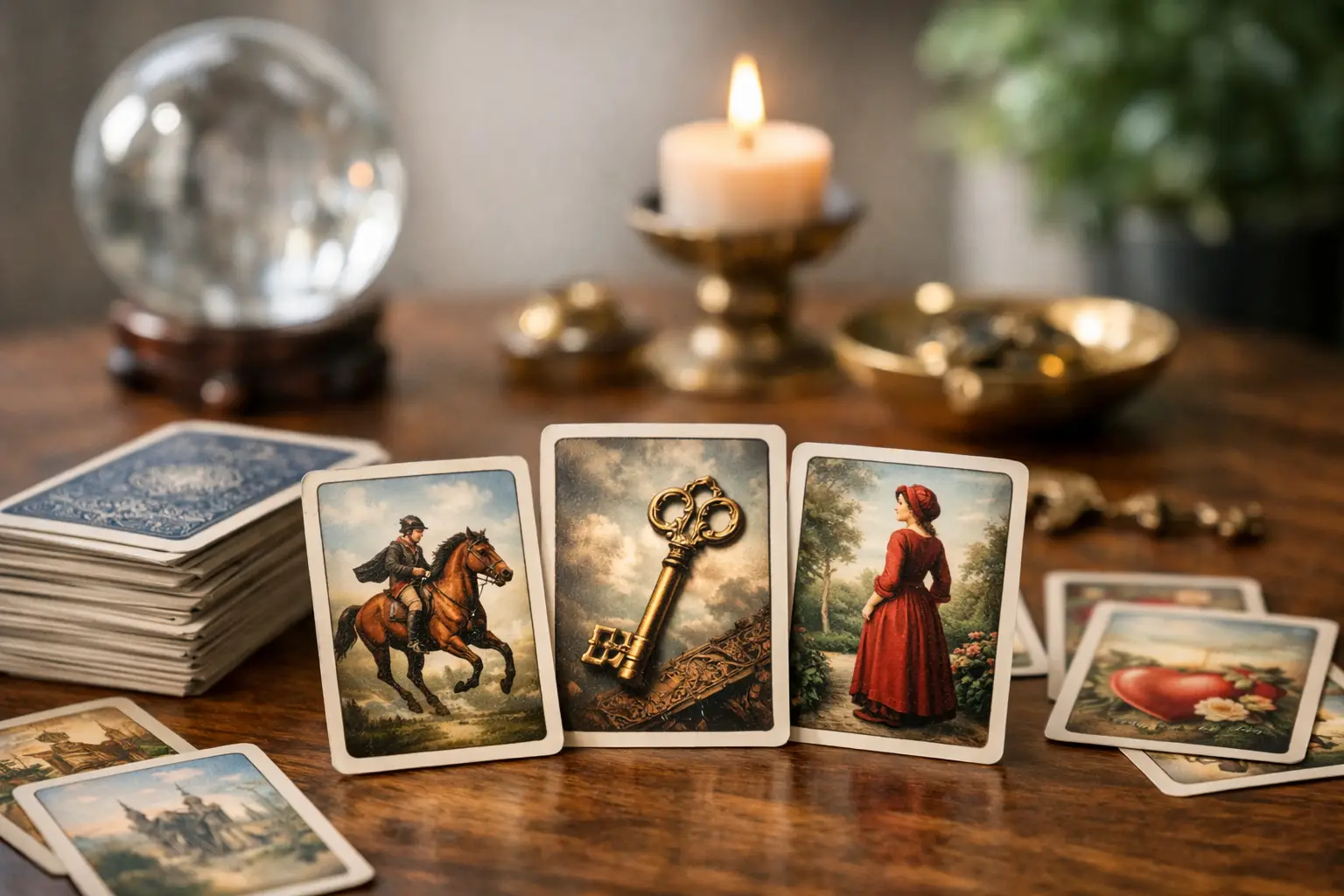
The Lenormand deck usually contains 36 cards, each linked to a simple symbol such as the Rider, Clover, Ship, House, Snake or Heart. On the surface, these symbols look ordinary. That is the point. Lenormand speaks through everyday life, which is why readings can feel so grounded.
A card like the House may point to home, family, property or stability. The Ship may suggest travel, distance, trade, movement or longing for something beyond your current circumstances. The Ring can describe commitment, contracts, repetition or cycles that keep returning. None of these meanings are random, but none are fixed to one narrow interpretation either.
This is where many beginners get stuck. They want one permanent answer for each symbol, yet Lenormand works better when you ask, what does this card mean here, in this question, next to these cards? A Snake beside the Heart feels very different from a Snake beside the Garden. One might hint at complications in love, while the other could point to social politics, gossip or a complicated group setting.
Lenormand card meanings in plain language
Learning lenormand card meanings becomes far easier when you stop trying to make them mystical. Most cards can be understood through a handful of practical themes.
Positive cards often include the Sun, Stars, Bouquet and Child. These can suggest joy, hope, attraction, freshness, success, innocence or an opening path. Challenging cards often include the Scythe, Whip, Cross and Mice. These may point to stress, endings, arguments, burdens, anxiety or slow depletion. Neutral cards such as the Letter, Book, Tree and Dog gain meaning from the question and surrounding cards.
For example, the Book does not automatically mean something hidden in a dramatic sense. It may simply point to study, private information, things not yet known, or a message that has not fully opened. The Dog is often loyal support, friendship or trust, but in some readings it can describe dependence or a person who stays close for reasons of their own. The card itself is not good or bad. It depends on the pattern around it.
That balance matters because Lenormand is not designed to flatter you. It is designed to show you what is there. When a difficult card appears, it is not a punishment. It is information. If you are asking about a relationship and see Heart, Ring and Coffin, the reading may be showing an emotional bond that is ending, changing form, or moving through a closure that cannot be ignored. Clear insight can be uncomfortable, but it is often what helps people move forward with more confidence.
Why combinations matter more than single cards
A single Lenormand card is like one sentence fragment. Helpful, yes, but incomplete. Two-card and three-card combinations are where readings start to become specific.
Take the Rider, which often means news, movement, arrival or someone coming in. Next to the Clover, it can suggest a lucky message or a brief opportunity arriving quickly. Next to the Clouds, it may point to mixed signals, confusion or delayed news. Beside the Heart, it could be romantic communication or an emotional approach from someone.
This combination style is what gives Lenormand its reputation for practical accuracy. Instead of saying, this card means love, full stop, the system asks you to read love with commitment, love with distance, love with conflict, love with secrecy, love with timing. That layered approach can be especially useful if you are asking about real-life choices rather than abstract spiritual themes.
If you want to build confidence, start by pairing cards and reading them as linked phrases. House and Tree might suggest family roots, long-term stability or health within the home. Fox and Letter may show a questionable message, workplace paperwork or a need to read the fine print. Anchor and Sun can be wonderfully steady, often pointing to stable success, security and energy returning.
How to read lenormand card meanings for love, work and timing
Lenormand is especially valued for direct questions. It is less about broad self-reflection and more about what is happening around a specific issue.
In love readings, cards such as the Heart, Ring, Moon and Dog often speak about connection, devotion, emotional recognition and loyalty. But the surrounding cards tell you whether the connection is easy, delayed, hidden, repeated or fading. Heart with Stars can feel hopeful and aligned. Heart with Mountain can show distance, blockages or slow progress. Ring with Birds might suggest anxious conversations about commitment, while Ring with Garden can point to a public relationship or social expectations around a partnership.
In career readings, cards like Fish, Anchor, Fox, Bear and Letter often appear. Fish can point to money, commerce, flow or multiple income streams. Anchor is work, stability and what keeps you grounded. Fox can be clever strategy, self-interest or workplace caution. Bear may indicate authority, leadership or financial protection. If you are asking whether a new role is worth pursuing, Fish with Sun may be a strong sign of growth and reward, while Anchor with Cross could show a role that is secure but heavy.
For timing, Lenormand can be helpful, though not every reader uses it the same way. The Rider often suggests speed. The Mountain can indicate delay. The Tree may imply slow development over time. The Scythe can bring sudden action. Timing in any divination system has limits, so it is best used as guidance rather than a guarantee. Still, if you want a clearer sense of pace around a situation, Lenormand often gives more structure than people expect.
Common mistakes beginners make
One of the biggest mistakes is reading Lenormand like tarot. Tarot welcomes intuition in a broad, symbolic way. Lenormand rewards intuition too, but it usually works best when the symbolism stays anchored to the question.
Another common mistake is overcomplicating every card. Not every Snake means betrayal. Not every Coffin means disaster. Sometimes Coffin simply shows an ending, a closed chapter, rest, or something that has run its course. Sometimes the Snake is strategy, complexity or a winding path rather than a malicious person.
It is also easy to ask vague questions and then feel disappointed by a vague answer. Lenormand shines when the question has shape. Ask about a connection, a decision, a move, a job offer, or whether communication is likely to come through. The clearer your focus, the clearer the reading tends to be.
Reading with intuition and structure
The strongest Lenormand readings blend both. Structure gives you a language. Intuition gives you tone, emphasis and relevance.
If you pull Moon, Tower and Letter, the structure may suggest recognition, isolation or authority linked to communication. Your intuition then helps you ask, is this a work message from a formal institution, emotional distance expressed through text, or public recognition arriving through written news? The cards narrow the field. Your insight completes the picture.
That is why Lenormand can feel so reassuring when life is messy. It does not always offer a comforting message, but it often offers a usable one. If you are standing at a crossroads, trying to understand someone’s intentions, or wondering whether to wait, act or let go, this system can bring a surprising amount of order to the unknown.
For many people, Lenormand becomes even more helpful when they talk the reading through with an experienced psychic who can spot combinations, patterns and timing cues they may miss on their own. At Soul 2 Path, that kind of guidance matters because clarity is not just about prediction – it is about helping you feel more steady in your next step.
The more time you spend with Lenormand, the more you notice that its real gift is honesty. These cards do not need to be dramatic to be powerful. Sometimes the clearest answer is also the one that helps you breathe, trust yourself, and choose what comes next with a little more peace.