If Tarot feels like poetry, Lenormand feels like plain speech. That is exactly why a guide to Lenormand card reading can be so useful when you want direct insight rather than broad symbolism. These cards tend to answer the question in front of you, especially around love, timing, work and day-to-day decisions, which makes them a favourite for people who want clarity they can actually use.
Lenormand is a 36-card system built on combinations. Each card has a core meaning, but the real message comes from how cards interact with one another. A Heart beside a Ring will speak differently from a Heart beside a Snake. That practical, sentence-like style is what sets Lenormand apart and why many people find it surprisingly accurate once they understand the basics.
What makes Lenormand different
One of the biggest misconceptions is that Lenormand works like Tarot with different artwork. It does not. Tarot often leans into psychology, archetypes and layered spiritual themes. Lenormand is more literal. It tends to describe events, dynamics, people and outcomes in a concise way.
That does not make it shallow. It simply means the system is designed for precision. If you ask about a relationship, Lenormand is likely to show whether communication is strong, whether a third party is influencing matters, or whether commitment is growing. It usually does this without too much haze.
This is also why beginners sometimes find Lenormand challenging at first. The cards are simple on their own, but reading combinations asks you to think in patterns rather than isolated meanings. Once that clicks, the system becomes far less intimidating.
A beginner’s guide to Lenormand card reading
The most helpful place to start is with the idea that every card is a keyword with a personality. The Rider can point to news, movement or someone arriving. The Clover often suggests luck, a short opportunity or something fleeting. The Mountain can show delays, obstacles or emotional distance. You are not trying to memorise a mystical essay for each card. You are learning the language of symbols.
Context matters. The same card can lean positive, negative or neutral depending on the question and the surrounding cards. The Dog may suggest loyalty in a love reading, but in a career question it could point to a trusted colleague or supportive client. The Scythe might mean a sharp decision, a sudden ending or the need to cut something off quickly. There is rarely just one rigid meaning.
This is where confidence builds. You do not need to be dramatic or overly psychic to read Lenormand well. You need calm attention, a clear question and a willingness to notice how the cards modify one another.
Start with the right question
Lenormand works best when your question is specific. Instead of asking, “What does my future hold?” ask, “What is unfolding in my relationship over the next month?” or “What energy surrounds my job application?” A clear question gives the cards a structure to respond to.
Vague questions often lead to vague answers. If you are feeling emotionally overwhelmed, it can help to narrow your focus before you shuffle. Ask about one person, one decision or one timeframe. You can always pull another spread afterwards if something needs more detail.
This matters even more if you are reading for yourself. When emotions are high, people tend to ask the cards to solve everything at once. Lenormand is far more effective when you let it address one thread at a time.
Learn the core card roles first
Before attempting larger spreads, get comfortable with a few cards that appear often in practical readings. The following examples show how direct Lenormand can be.
The Sun usually brings success, energy, warmth and visibility. The Moon leans towards emotions, recognition and intuition, though in some contexts it can show moodiness or uncertainty. The Book often points to secrets, hidden information, study or something not yet revealed. The Key suggests certainty, significance and a clear yes. The Clouds show confusion, mixed signals or uncertainty that has not yet cleared.
Then there are cards that shape relationships and daily life strongly. The Ring can indicate commitment, contracts, repetition or cycles. The Cross often points to burdens, spiritual lessons or heaviness. The Child may show something new, innocence or a smaller version of the issue. The Fox can suggest caution, self-interest, strategy or work, depending on context.
Notice how practical these are. You can almost hear the sentence forming as the cards sit together on the table.
How to read combinations without overthinking
The easiest way to read Lenormand combinations is to treat them like linked phrases. Start with two cards. Ask how one card affects the other.
For example, Heart plus Letter can suggest a love message, emotional news or honest communication. Tower plus Garden could point to public distance, an institution, or someone feeling isolated within a social setting. Fish plus Anchor may suggest stable finances or being deeply tied to business matters.
Direction can matter depending on your method, but beginners do not need to make it overly technical. What matters first is learning how one symbol colours the other. Positive cards can soften difficult ones, while heavier cards can complicate otherwise bright messages.
If a combination feels confusing, bring it back to the question. A Snake in a business reading may suggest strategy or a difficult woman. In a romance reading, it may raise concerns about manipulation, jealousy or a triangle. Meaning grows out of context.
The best spreads for beginners
You do not need a Grand Tableau on day one. In fact, many people learn faster by keeping things small.
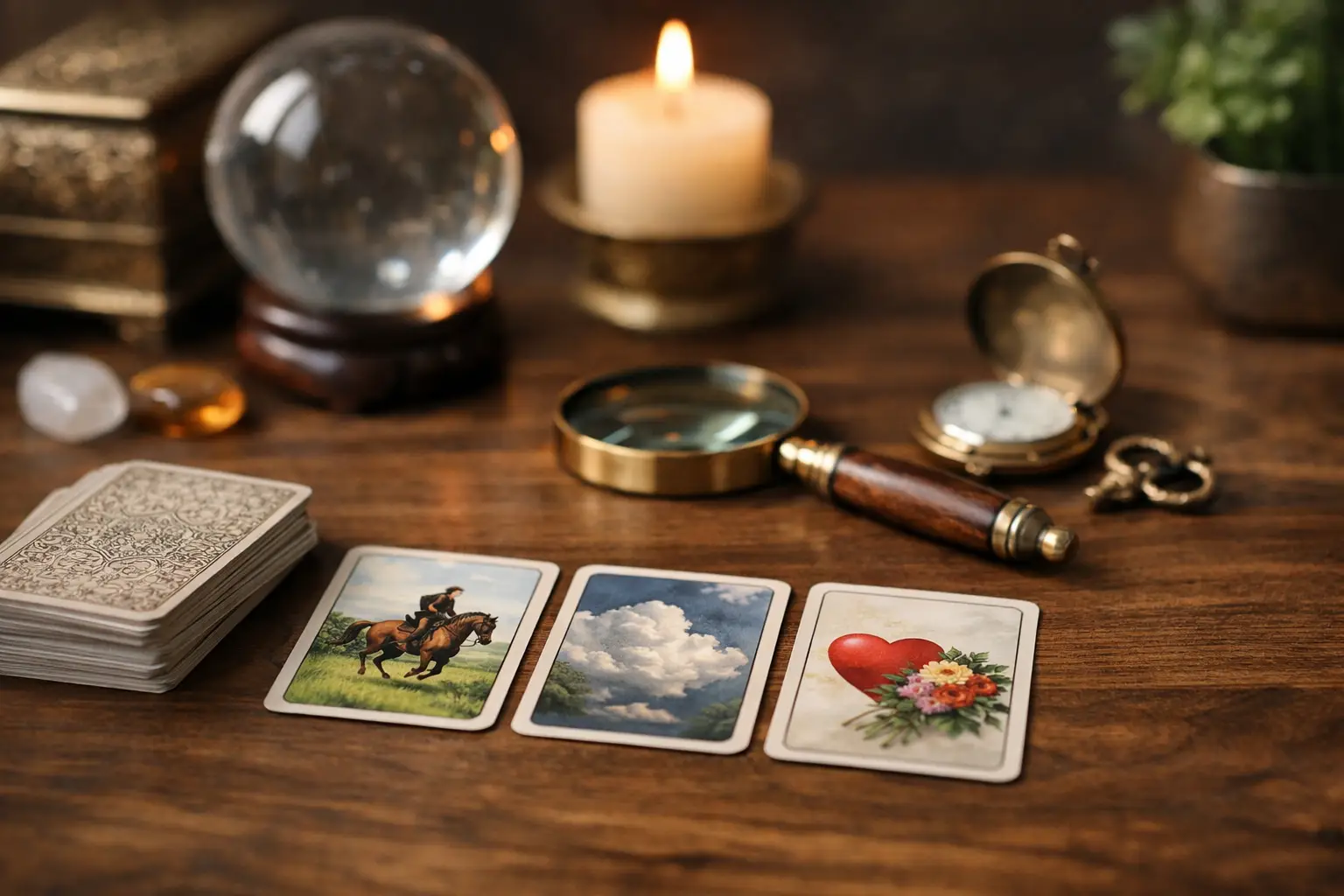
A three-card spread is ideal for everyday guidance. You can read it as past, present, future, or as situation, challenge, outcome. This is often enough for questions about contact, intentions or the next step.
A five-card line gives more detail and helps you practise card flow. It is useful when a situation has several moving parts, such as a relationship shift or a work change. Read the centre card as the heart of the issue, then notice how the cards on either side influence it.
A nine-card box can add depth once you are comfortable. It helps when you want to understand what is visible, what is hidden and where things are heading. Larger spreads can be powerful, but they also create noise if your foundations are not steady yet.
Common mistakes in a guide to Lenormand card reading
The first mistake is trying to force Tarot habits onto Lenormand. If you read every card as a spiritual life lesson, you may miss the practical answer. Lenormand usually tells you what is happening, not just how to feel about it.
The second is reading single cards in isolation. While one-card pulls can be useful for practice, Lenormand shines through combinations. A Bouquet on its own is pleasant. Bouquet with Coffin may suggest a gift that does not last, or joy fading quickly. The message changes because the cards are speaking together.
The third is asking the same question repeatedly when you are anxious. This tends to muddy your reading and heighten projection. If the answer feels uncomfortable, pause before reshuffling. Clarity often needs stillness.
How to strengthen your intuition with Lenormand
Lenormand is structured, but intuition still matters. The structure gives your intuition somewhere solid to land. That is a helpful balance for people who want spiritual guidance without feeling lost in abstraction.
A simple reading journal can speed up your progress. Write the question, the cards, your first interpretation and what later happened. Over time, you will notice your own symbolic language becoming sharper. Perhaps the Ship repeatedly shows interstate travel for you, or the Birds consistently appear around anxious texting. Those personal patterns matter.
It also helps to read when you are grounded rather than frantic. A calm five-minute reading will usually give more insight than a panicked half-hour spiral. If the issue feels too emotionally loaded, seeking guidance from an experienced reader can offer reassurance as well as perspective.
When Lenormand is especially helpful
Lenormand is particularly strong when you want practical guidance around timing, communication, relationships, work decisions and hidden dynamics. It is often the right tool when you need to know what energy is surrounding a situation and what is most likely to happen next.
That said, it depends on what you are seeking. If you want deep soul themes or emotional healing work, Tarot or astrology may feel richer. If you want a straightforward snapshot with less symbolism to untangle, Lenormand can be incredibly effective. Many spiritually minded people use both for that reason.
For anyone seeking direct answers with a touch of intuition, Lenormand offers a grounded path forward. And when life feels uncertain, sometimes the most comforting message is also the clearest one – this is what is here, this is what is changing, and this is where your next step begins.