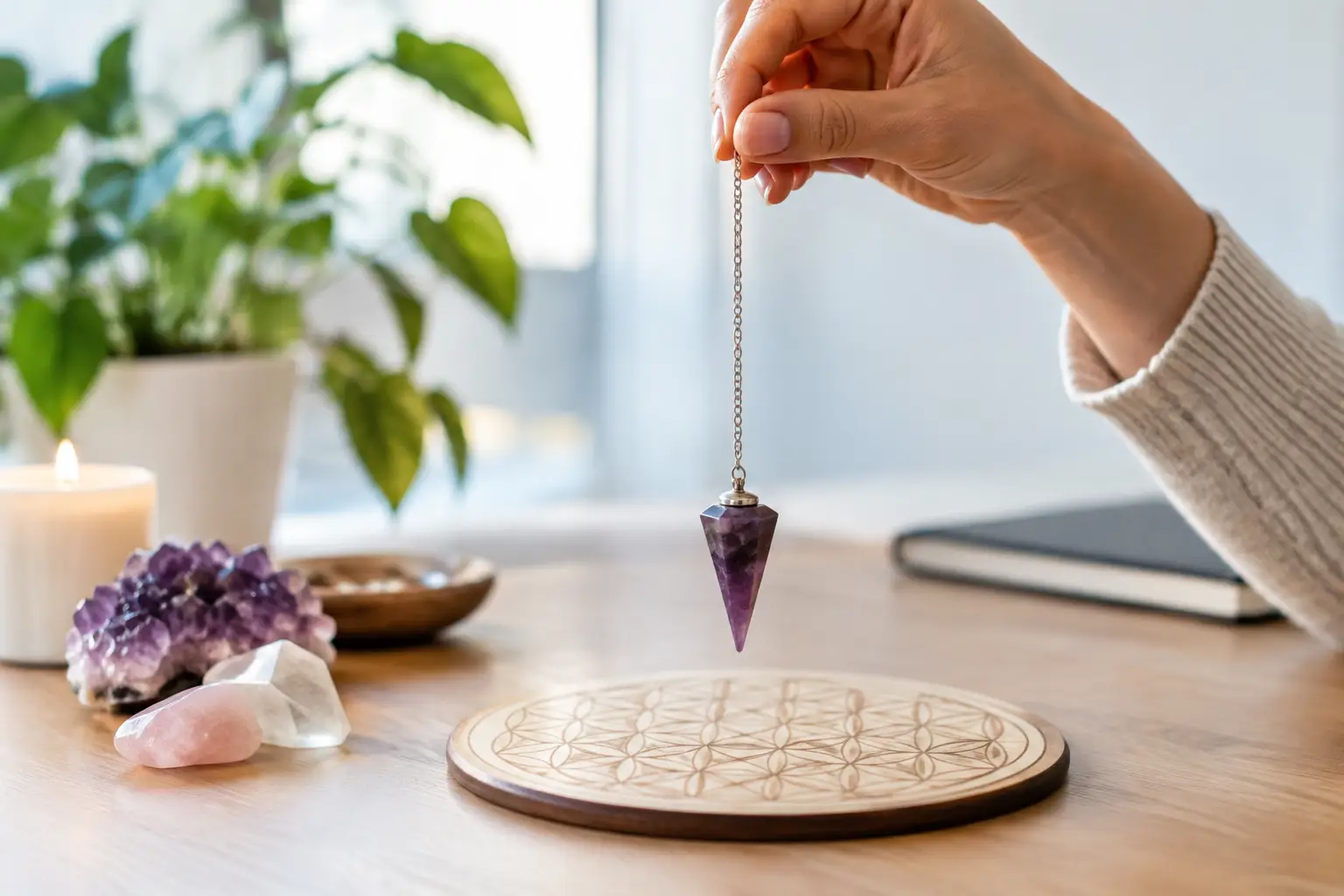
You have asked the same question three times, weighed up every possible outcome, and still cannot feel which way to move. That is often the moment people reach for a pendulum. But do pendulums work in a way that can genuinely help you find clarity, or are they simply moving because your hand expects them to?
The honest answer is more nuanced than a simple yes or no. A pendulum is not a guaranteed forecasting device, and it should never replace sound judgement, professional advice or your own agency. Yet many people find that using one creates a quiet, focused space where their intuition, feelings and unspoken preferences become easier to hear. Used with care, pendulum guidance can be a meaningful tool for reflection.
So, do pendulums work?
From a scientific perspective, pendulum movement is often explained by the ideomotor effect. This is when small, unconscious movements in your hand influence an object without you deliberately choosing to move it. If you expect a swing to mean yes, for example, your body may make tiny adjustments that create that swing.
That does not have to make the experience pointless. Our minds hold impressions that do not always arrive as clear, logical thoughts. When you slow down, ask a focused question and watch the movement of a pendulum, you may notice a response within yourself before you can explain it. For some, the pendulum becomes a mirror for inner knowing. For others, it is a spiritual practice that helps them tune into guidance beyond the everyday mental noise.
Where the line matters is certainty. Pendulums have not been shown to reliably predict future events or provide verifiable answers to every unknown. Their value is often most useful in the quality of reflection they invite, not in treating every answer as an unchangeable fact.
What a pendulum can help you explore
A pendulum works best with questions that bring you back to your own awareness. It may help you explore whether an option feels settled or uneasy, whether you are ready to take the next step, or what part of a decision needs more attention.
For example, if you are deciding whether to reconnect with an ex, a pendulum cannot tell you with certainty how they will behave next month. It can, however, bring your present feelings into focus. Does asking about contact bring a sense of calm, tightness, hope or dread? That information is valuable. It may reveal the question beneath the question: not “Will they come back?”, but “Would reconnection be kind to me?”
This is why clear wording matters. Broad questions such as “Will I be happy?” can carry too much uncertainty and emotion to produce a useful result. Questions rooted in your current choice are often more grounding: “Am I ready to have this conversation?” or “Would gathering more information support this decision?”
How pendulum guidance works for different people
Every person approaches spiritual tools differently. Some people see pendulum work as a way to communicate with their higher self, spirit guides or universal energy. Others prefer a psychological view, using it as a gentle prompt to identify subconscious thoughts. You do not need to force yourself into one explanation for the practice to be worthwhile.
What matters is your intention. If you sit down desperate for a particular answer, anxious about every movement, or determined to ask the same question until you receive the result you want, the pendulum is unlikely to bring peace. It can become another loop of reassurance-seeking.
A steadier approach is to treat the response as one piece of insight. Notice it, journal what comes up, and then consider the facts in front of you. Intuition and practical action can work together. A spiritual tool may point to an emotional truth, while a sensible plan helps you act on it safely.
How to use a pendulum with clarity
There is no need for an elaborate ritual. Choose a pendulum that feels comfortable in your hand, whether it is crystal, metal, wood or a sentimental object on a chain. Sit somewhere quiet, rest your elbow if that helps, and hold the chain so the pendulum hangs freely.
Start by taking a few slow breaths. You are not trying to become perfectly blank or achieve a dramatic mystical moment. You are simply creating enough stillness to listen.
Before asking your question, establish what your signals mean. You might ask the pendulum to show you a yes, then a no, then a neutral or unclear response. Some people experience a forward-and-back swing for yes and side-to-side for no. Others see circles. There is no universal pattern, so use the signals you receive consistently during that session.
Ask one question at a time, keeping it plain and specific. Then wait without forcing the movement. If the pendulum barely shifts, changes direction repeatedly or gives a response that leaves you more muddled, take that as information too. It may not be the right question, the right moment, or a decision that can be reduced to yes or no.
When you finish, put the pendulum down and take a moment to check in with yourself. Were you relieved by the answer? Disappointed? Did you instantly argue against it? Your reaction may hold more guidance than the swing itself.
Questions to avoid
Pendulums are not suited to questions that hand over your wellbeing or responsibility. Avoid using one to make urgent medical, legal or financial decisions, to assess safety, or to replace help from a qualified professional. If you feel unsafe, overwhelmed, or unable to make daily decisions without repeated checking, step away from the tool and seek practical support.
It is also wise to avoid trying to use a pendulum to control another person’s privacy or choices. Questions about someone else’s feelings can be tempting during heartbreak or uncertainty, but a more empowering focus is what you need, what boundaries support you, and what choice aligns with your values.
Why your emotional state changes the reading
Your state of mind shapes every intuitive practice. If you have just had an argument, received upsetting news or spent hours scrolling for signs, your nervous system may be looking for certainty rather than insight. In that state, even a simple pendulum question can feel loaded.
Try returning later after a walk, a shower, meditation or a good sleep. You may receive a different response, not because the pendulum has failed, but because you are meeting the question from a calmer place. Clarity is rarely about forcing an answer on demand. It is about becoming present enough to recognise what is true for you now.
This is also why it helps to keep a small record of your sessions. Write down the question, the response, your feelings and what unfolded afterwards. Over time, you can see patterns in how you use the tool. Perhaps it helps you trust decisions you already sensed. Perhaps it shows you when anxiety is steering the session. Both discoveries can strengthen self-awareness.
When a reading can offer deeper perspective
A pendulum can be a beautiful personal practice, especially for quick check-ins and moments of reflection. But some questions carry more weight than a yes or no can hold. Relationship crossroads, career changes, grief and big life transitions may call for a fuller conversation.
A reading with an experienced psychic can give you room to explore the layers around a situation rather than chase one fixed outcome. At Soul 2 Path, you can speak with a reader privately by mobile, SMS or email, whenever you need support to understand the energy around your path and move forward with greater confidence.
Let a pendulum be an invitation to pause, not a substitute for your power. The most helpful guidance should leave you feeling more connected to your own wisdom, more able to ask honest questions, and more prepared to take the next grounded step.