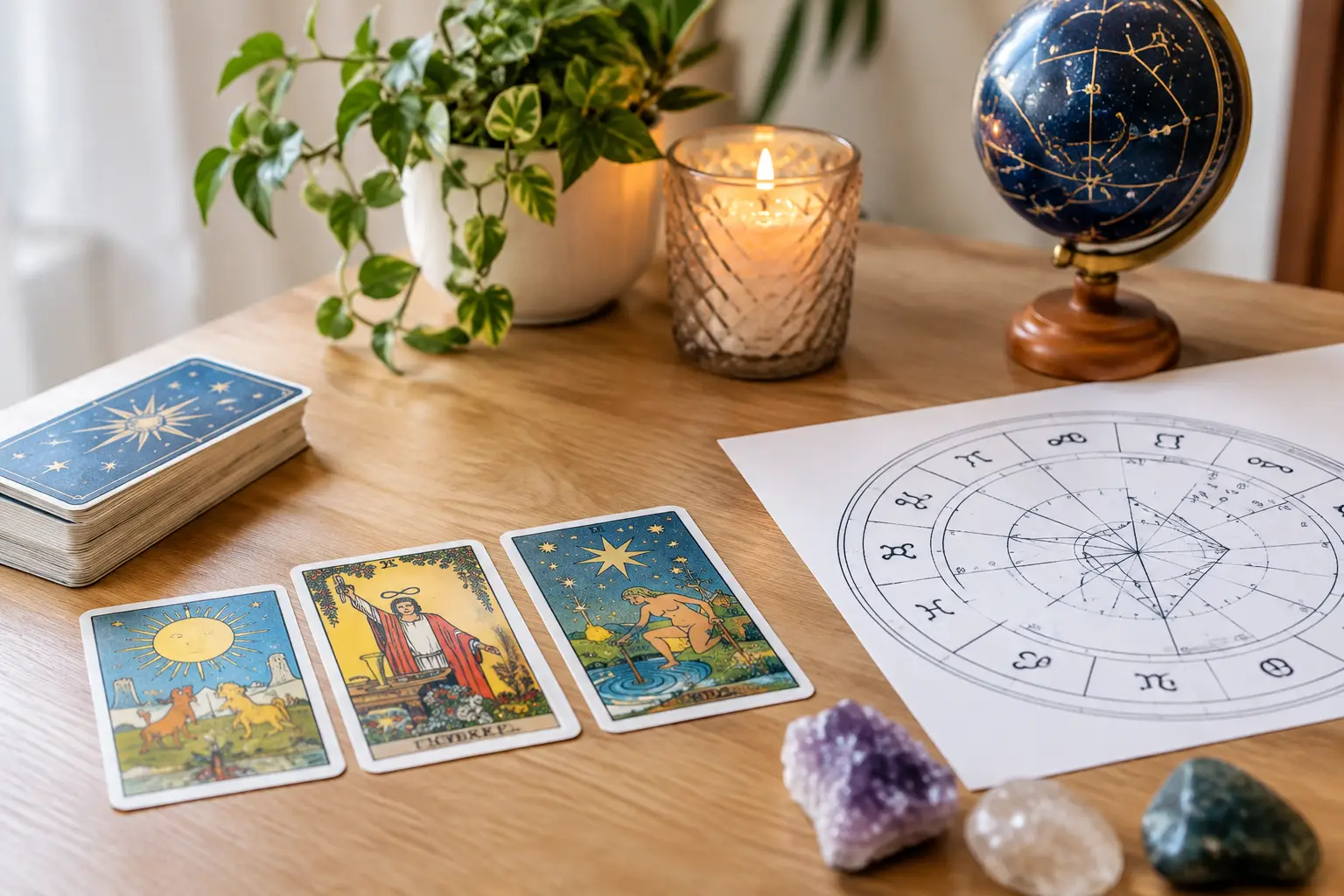
When you are standing at a crossroads, the question is rarely just, “What will happen?” More often, it is, “What am I missing?” A tarot astrology comparison can help you choose the form of spiritual guidance that best meets that moment – whether you need perspective on a relationship, reassurance around a decision, or a clearer sense of the cycles shaping your life.
Tarot and astrology are often placed in the same spiritual basket, but they work in distinct ways. One reads the energy and themes surrounding a question now. The other maps the symbolic patterns present at your birth and in the changing skies. Both can be deeply personal, but the experience, focus and kind of insight you receive can feel very different.
Tarot and astrology: the essential difference
Tarot is a card-based intuitive practice. During a reading, cards are selected and interpreted in relation to your question, current circumstances and emotional energy. A skilled reader looks beyond a single card meaning to see the story emerging across the spread. This makes tarot especially useful when life feels immediate, layered or emotionally charged.
Astrology works with the positions of the Sun, Moon, planets and other celestial points. Your natal chart is calculated from your date, time and place of birth, creating a symbolic map of your personality, motivations, relationships, strengths and recurring lessons. Ongoing planetary movements, known as transits, are then considered alongside that chart to explore the timing and tone of a particular period.
Put simply, tarot often speaks to the present crossroads, while astrology offers a wider view of your natural patterns and life seasons. Tarot may ask, “What is asking for your attention in this situation?” Astrology may ask, “Why does this theme keep returning, and what cycle are you moving through?”
Neither approach has to be treated as fixed fate. The value of a reading is not in handing your power to cards or planets. It is in creating space to recognise what you already sense, consider possibilities with more honesty and make choices that align with your values.
Tarot astrology comparison: what each can help with
The best choice depends on the question you are bringing. Tarot is often a natural fit when your question has movement in it. You may be deciding whether to reach out after a breakup, wondering what is creating tension at work, or feeling torn between two paths. The cards can draw out the emotional dynamics, blind spots and practical next steps around a specific concern.
Because tarot responds to the energy of the reading, it can be wonderfully flexible. You do not need to know your birth time or arrive with a perfectly formed question. You might begin with, “I feel stuck,” and work with the reader to understand where that feeling is coming from. For people who are carrying grief, uncertainty or relationship stress, this can feel validating and grounding.
Astrology tends to shine when you want context. Perhaps you keep choosing partners who are emotionally unavailable. Perhaps your career has reached a point where the old version of success no longer fits. A natal chart can illuminate the deeper tendencies at play – not as a judgement, but as a language for self-understanding.
Astrology can also be useful for exploring timing. A transit reading may show why a period feels more introspective, demanding or expansive than usual. It will not remove your responsibility to act thoughtfully, and it should not be used to make high-stakes decisions without practical advice. Yet it can help you pace yourself and understand why certain areas of life feel more active.
When tarot may feel more helpful
Choose tarot when you want insight that is immediate, personal and centred on a live situation. It can be especially supportive for questions about love, communication, decisions, family matters and emotional healing. A tarot reading also suits people who prefer a conversational experience, where the reader can respond to what emerges as you talk.
Tarot is not always the clearest choice if you are looking for a detailed overview of your lifelong traits or a technical exploration of timing. While cards can reveal patterns, they do not replace the particular depth of a natal chart.
When astrology may feel more helpful
Choose astrology when you want to understand yourself across a broader arc. Your birth chart can offer language for your emotional needs, relationship style, ambitions and the areas where you may be learning important lessons. It is often meaningful during major transitions, such as a career change, becoming a parent, relocating or reassessing a long-term relationship.
The trade-off is that astrology can feel less direct if your concern is urgent and specific. It also relies on accurate birth details, particularly your birth time. Without them, some chart elements may be less precise. A good astrologer will be transparent about that rather than presenting every interpretation as certain.
The experience of a reading is just as important
A tarot session often feels like a guided conversation with visual symbols. The images can make complicated feelings easier to name. You may recognise yourself in the themes of the cards before you can explain them logically, which is part of why tarot can bring such a strong sense of emotional clarity.
An astrology session can feel more like being given a map and learning how to read it. There may be more terminology at first, such as houses, aspects or transits, but a thoughtful reader will translate the chart into plain, relevant language. You should leave with insight that feels applicable to your life, not overwhelmed by technical detail.
In either format, the reader matters. Look for someone who is respectful, clear and willing to explain their approach. Genuine guidance should make room for your own judgement. It should not create fear, pressure you into repeated sessions or claim absolute authority over your future.
Why combining tarot and astrology can be powerful
You do not have to choose one practice forever. Tarot and astrology can complement each other beautifully because they offer different lenses on the same concern. Astrology might show that you are in a period of reassessing commitment, identity or work. Tarot can then explore what that cycle is asking of you right now and where your energy is best placed.
For example, if an astrology reading highlights a season of change in your relationships, tarot might help you explore a current connection with more tenderness and honesty. If tarot repeatedly brings up themes of confidence or boundaries, astrology may offer a deeper view of the personal pattern behind them.
Using both does not mean collecting more predictions. It means building a fuller conversation with yourself. The strongest readings connect spiritual insight with your lived reality: the conversation you need to have, the rest you have been avoiding, the boundary you need to hold, or the opportunity you are ready to consider.
How to choose the right guidance for your question
Before booking a reading, take a quiet moment to notice what you most need. If your concern is, “What is happening between us?” or “How can I move forward from this?” tarot may offer the focused, present-centred support you are seeking. If your question is, “Why do I keep experiencing this?” or “What themes are shaping this chapter of my life?” astrology may be the better starting point.
You can also bring your question to a reader and ask which approach they recommend. At Soul 2 Path, guidance is available in flexible formats, so you can choose a private reading experience that suits your comfort level and schedule. Whether you connect by phone, SMS or email, a clear question can help your reader meet you where you are.
Try to stay open without placing pressure on a reading to deliver a perfect answer. Insight can arrive as confirmation, a new perspective or a gentle challenge to the story you have been telling yourself. Take what resonates, reflect on it over time and let your own wisdom remain part of every decision.
The right path is not always the one that removes uncertainty straight away. Sometimes it is the one that helps you meet uncertainty with a steadier heart, clearer boundaries and the confidence to take the next honest step.