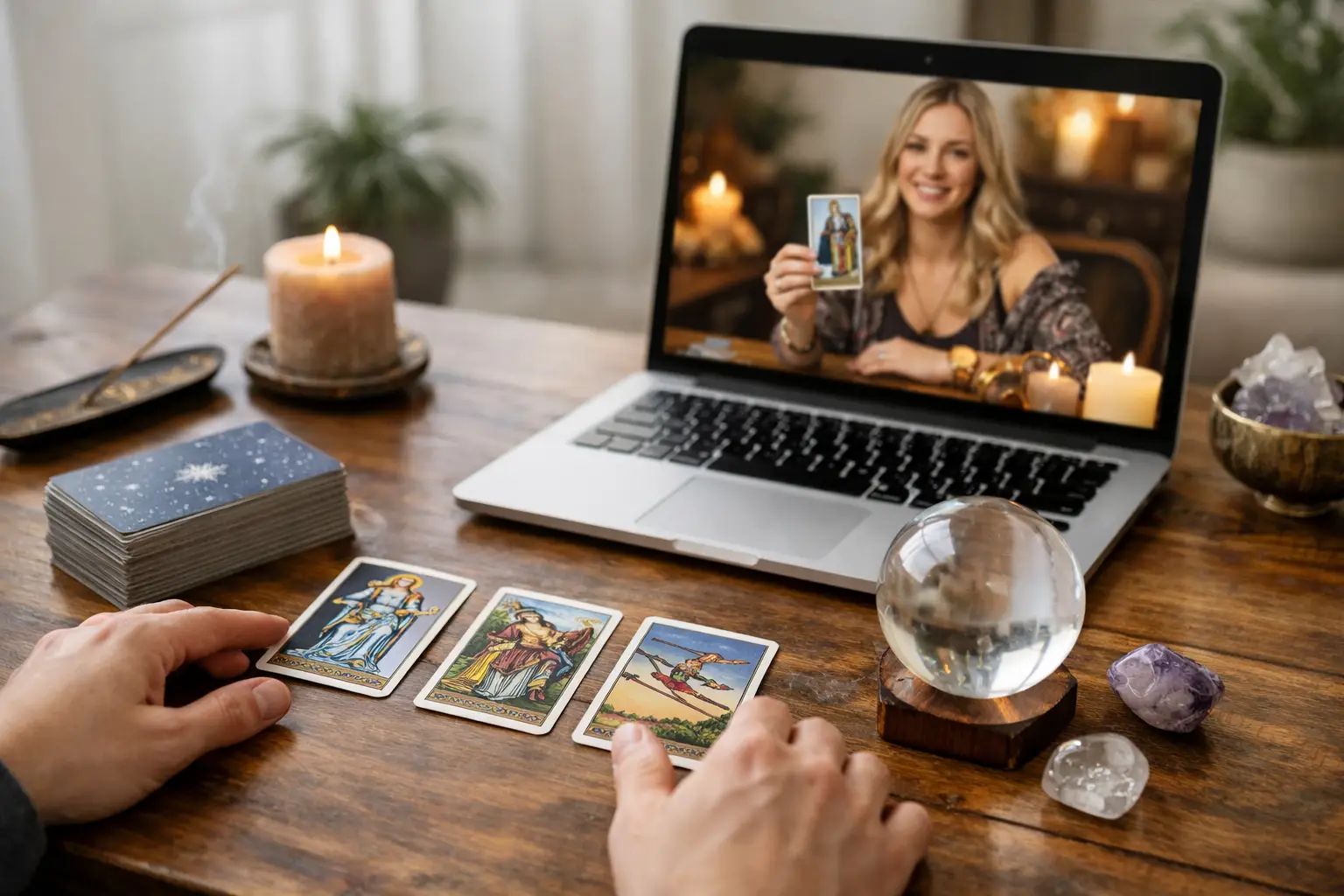
You do not need to have your whole life mapped out before a tarot reading. Often, the most meaningful sessions begin with one honest feeling: something has shifted, and you want clarity on what comes next. This guide to online tarot readings is designed to help you approach a reading with an open mind, sensible expectations and questions that matter to you.
Online tarot makes spiritual guidance more accessible when you are weighing up a relationship, work decision, family matter or change in direction. You can seek insight from the privacy of home, at a time that suits you, without needing to explain every detail to someone face to face. The cards offer a reflective starting point. A skilled reader helps you connect their symbols and patterns to your personal circumstances.
What an online tarot reading can offer
Tarot is not about handing over control of your future. It is a tool for perspective. Each card carries themes that can bring underlying feelings, recurring patterns and possible choices into clearer view.
A reading may help you name what you already sense but have struggled to articulate. For example, the Eight of Cups may speak to emotional withdrawal or the need to leave a situation that no longer feels aligned. The Lovers can raise questions about values, commitment and conscious choices – not simply romance. Context matters, which is why the reader’s intuition and the conversation around the cards are as valuable as the spread itself.
For some people, tarot brings reassurance during an uncertain time. For others, it creates a gentle prompt to look at a situation differently. It can be particularly helpful when your thoughts are going in circles and you need space to pause, reflect and reconnect with your own inner knowing.
That said, tarot is guidance rather than a guarantee. It should support your decision-making, not replace practical judgement, professional medical, legal or financial advice, or your right to choose what feels right for your life.
Guide to online tarot readings: choosing the right format
The best format is the one that helps you feel comfortable enough to be open. A live phone reading can feel immediate and personal, allowing you to ask follow-up questions as the cards are interpreted. It suits moments when you want to talk something through and receive insight in real time.
An SMS tarot reading can be a thoughtful option when discretion matters or you prefer time to sit with each message. It may suit a focused question, such as the energy around a new connection or what you need to understand about a decision. Email readings can give you a written response to revisit later, which can be helpful when there are several layers to your question.
There is no universally better option. If you tend to process by talking, a live reading may feel more natural. If you feel emotional, busy or unsure of what to say, a written format can provide breathing room. What matters is choosing a service with clear reader information, transparent pricing and secure payment, so your attention stays on the guidance rather than the process.
Look for connection, not dramatic promises
A reader does not need to tell you only what you hope to hear. The right connection often feels calm, respectful and grounded. They should make room for your questions, avoid judgement and share insight in a way that leaves you feeling more supported, not dependent or frightened.
Be cautious of anyone who claims certainty about every outcome, pressures you to spend more, or tells you that only they can remove a problem from your life. Genuine tarot guidance honours your agency. It helps you see possibilities and make aligned choices with greater confidence.
Reader profiles, availability and client reviews can be useful when choosing who to speak with. Consider the areas a reader is drawn to, such as love, career, family dynamics, spiritual growth or timing. A reader whose approach matches your concern may be a better fit than simply choosing the first available appointment.
Prepare a question with room for insight
You do not need a perfectly worded question. In fact, the most powerful questions are usually simple, specific and open enough to invite meaningful guidance.
Instead of asking, “Will my ex come back?”, you might ask, “What do I need to understand about this connection?” or “What would support my healing and clarity in love?” Rather than, “Will I get the job?”, try, “What energy should I bring to this opportunity?” These questions keep the focus on your choices, needs and next steps.
Before your session, take a quiet moment to notice what is really sitting beneath the question. Are you seeking reassurance, closure, confidence, permission to change direction, or a clearer sense of timing? You can share as much or as little background as you like. A good reader will work with the information you feel comfortable providing.
It can help to keep a notebook or the notes app on your mobile nearby. Write down a few key points from the reading, especially any card names, themes or practical suggestions that stay with you. You do not need to capture every word. The aim is to leave room for your own response as the guidance settles.
What happens during a remote tarot reading
Most online tarot readings begin with a brief check-in. You may be asked what area of life you would like to explore, whether you have a particular question, and what level of detail feels comfortable. The reader then draws cards using a spread that suits the situation, such as a simple past-present-future layout or a more detailed relationship or decision spread.
As the cards appear, the reader interprets their traditional meanings alongside the position they hold in the spread and the intuitive impressions that arise. This is where a reading becomes personal. The same card can carry a different emphasis depending on the question, the surrounding cards and what is happening in your life.
You are welcome to ask for clarification. If a message feels vague, ask how it may relate to your situation. If a card brings up a feeling, say so. A reading is not a test that you must pass by staying silent. It is a conversation with space for curiosity.
Sometimes the message feels immediately clear. At other times, it makes more sense a few days later, after a conversation, decision or shift in perspective. Give yourself permission not to force an interpretation on the spot.
How to make the most of your reading afterwards
The cards may point to an action, a boundary, a conversation worth having or a pattern worth watching. Choose one grounded step rather than trying to change everything at once. If your reading highlights exhaustion, the next step might be protecting an evening for rest. If it brings attention to communication in a relationship, it could be preparing for an honest, kind conversation.
Avoid repeatedly asking the same question in a short period because the answer feels uncomfortable. Tarot is most useful when you allow enough time to reflect, act and notice what unfolds. If circumstances genuinely change, a fresh reading can offer a new perspective. Otherwise, returning immediately can create more confusion than clarity.
It is also worth noticing how you feel after a reading. Ideally, you should feel steadier, more self-aware or more able to see your options, even when the message is challenging. A reading does not need to predict a perfect outcome to be valuable. Its value is in helping you meet your path with honesty and intention.
When tarot is most helpful
Tarot can be a supportive companion through transitions: the start or end of a relationship, a career crossroads, a move, grief, a confidence wobble or a period when your usual certainty has gone quiet. It can also be a meaningful practice when nothing is wrong and you simply want to check in with your energy and direction.
If you are new to tarot, begin with one area of focus and a short session. Services such as Soul 2 Path make it easier to explore guidance in the format that feels right for you, with reader availability and clear pathways that reduce the pressure of taking the first step. You do not have to know every card or hold a particular belief to receive something useful from the experience.
Bring your real question, stay open to what arises and let the reading be a moment of connection with your own wisdom. The clearest path is often not the one that appears all at once, but the next honest step you feel ready to take.