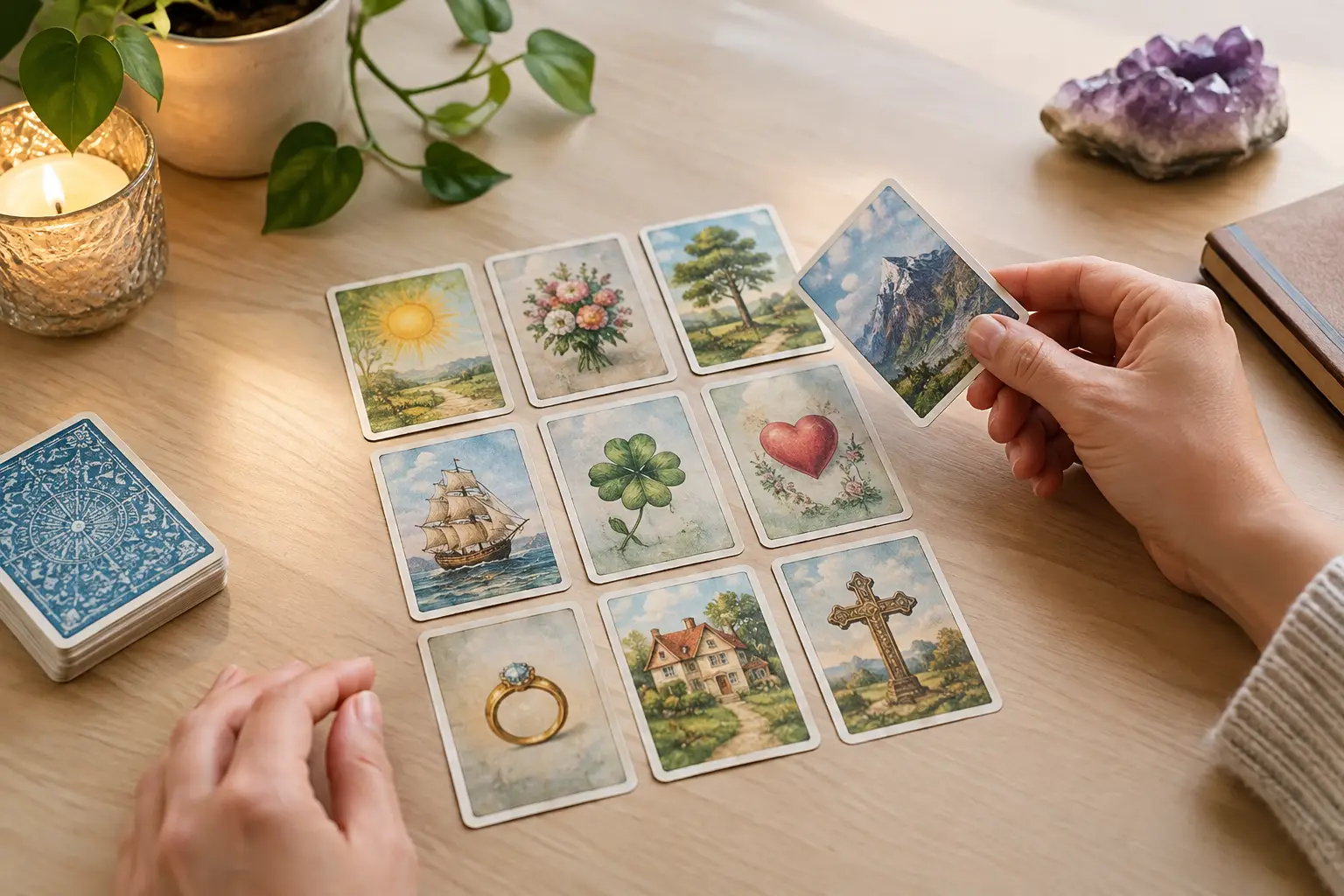
A Lenormand spread can look deceptively simple: a Rider, a Clover and a Letter may appear like three unrelated pictures at first glance. Yet together, they can describe news arriving quickly and bringing a lucky opening. That direct, story-like quality is what makes lenormand reading for beginners so approachable – and so different from reading tarot.
Lenormand is not about finding one perfect definition for every card. It is about noticing how cards speak to one another, then applying that message to a clear, real-life question. With a little structure and an open mind, you can begin reading with confidence without memorising a book of complicated symbols.
What Makes Lenormand Different?
Traditional Lenormand decks contain 36 cards, each with a central symbol such as the Heart, the Key, the Ship or the Crossroads. The symbols are usually practical and concrete. The House can point to home, family or security. The Ring may speak of commitment, an agreement or a repeating pattern. The Fox can suggest work, self-interest or the need to look more closely.
Tarot often explores inner feelings, archetypes and spiritual lessons through one card at a time. Lenormand tends to be more literal, especially when cards are read in combinations. It can be particularly helpful when you are seeking clarity around communication, relationships, work choices, timing or the direction of a situation.
That does not mean every reading is fixed or fated. Your choices, boundaries and willingness to act still matter. Think of the cards as a way to bring the pattern into focus, so you can respond with greater awareness.
Start Your Lenormand Reading for Beginners Journey
Choose a deck with clear, traditional imagery. Many modern decks are beautifully illustrated, but a classic-style deck can make learning easier because the symbols are obvious. You do not need a costly deck or a large collection to begin. One deck you connect with is enough.
Before you shuffle, create a small pause. Put your mobile aside, take a few steady breaths and decide what you genuinely want to understand. Lenormand responds best to specific questions. Rather than asking, “What will happen in my life?”, try, “What energy surrounds my job interview this week?” or “What should I know about this conversation with my partner?”
A focused question does not limit intuition. It gives your reading somewhere useful to land.
Learn the Core Meanings First
Start by becoming familiar with the everyday language of the cards. You do not need to master all 36 meanings overnight. Begin with a few common cards and let them become familiar through repeated use.
The Rider often brings news, movement or a visitor. The Clover suggests a brief opportunity, good fortune or something small but welcome. The Clouds can show uncertainty, mixed messages or confusion. The Sun brings success, warmth and visibility, while the Moon may point to emotions, recognition, intuition or creative work.
Some cards can change slightly depending on the question and neighbouring cards. The Bear, for example, may represent strength, protection, money, leadership or a powerful person. This is not inconsistency. It is context. The surrounding cards show which meaning makes the most sense in that particular reading.
Keep a notebook beside you as you learn. Write the date, your question, the cards drawn and your first impression before checking a guidebook. Over time, you will see how the cards speak in your own life.
Read Card Combinations Like a Sentence
The most valuable early skill is learning to connect cards rather than treating each one as a separate answer. In Lenormand, card order matters. A simple way to begin is to read from left to right, as though the cards are forming a short sentence.
Take the Heart and the Letter. Together, they can suggest a loving message, heartfelt communication or a conversation about feelings. Reverse the order to Letter and Heart, and the focus may be news that creates an emotional response or a message leading towards affection.
Consider the Ship and the Crossroads. This could describe travel decisions, a move, distance within a choice, or a new path that requires you to leave familiar ground. Add the Anchor after them and the story might become clearer: a decision about travel or relocation that affects long-term work, stability or commitment.
You do not need to force a poetic interpretation. Ask yourself what the symbols would mean if they appeared in an ordinary conversation. Let the reading be practical before making it mystical.
Try a Simple Three-Card Spread
A three-card spread offers enough detail to practise combinations without becoming overwhelming. Ask one direct question, shuffle and lay three cards from left to right.
You can read the positions as situation, challenge and guidance. For a question about a new relationship, the Bouquet, Fox and Ring might suggest an enjoyable connection that needs honest observation before commitment. The message is not necessarily that someone is being dishonest. It may be a gentle prompt not to ignore practical concerns simply because the connection feels exciting.
You can also read the three cards as a flowing timeline: what is developing, what is happening now and what is likely to come next if the current energy continues. If you draw Clouds, Key and Sun, the story may be that confusion is giving way to an answer, followed by a clearer and more positive outcome.
When you finish, avoid immediately drawing extra cards because you feel unsure. Sit with the original message for a moment. Extra cards can help when used deliberately, but repeatedly pulling cards can muddy a reading and feed anxiety rather than clarity.
Ask Questions That Support Clear Answers
Lenormand works well with questions that have a defined subject and timeframe. A question such as, “What should I understand about my finances over the next month?” gives the cards more direction than a broad request for reassurance.
If you are reading about another person, approach the question with care. Instead of trying to uncover every private thought, ask what you need to know to make an aligned decision. “What is the healthiest way for me to approach this relationship?” keeps the focus on your agency and wellbeing.
Yes-or-no questions can be useful, but they are often more revealing when followed by a practical question. Rather than stopping at “Will I get the job?”, ask, “What can I do to support the best outcome?” The cards are most helpful when they guide your next step.
Common Beginner Habits to Leave Behind
The urge to memorise every possible meaning is understandable, but it can make your readings feel stiff. Learn the core symbol first, then let the question and combinations refine it. A Dog is loyalty, friendship or support before it becomes anything more specific.
It also helps to avoid reading when you are highly distressed and hoping the cards will remove all uncertainty. In emotional moments, draw one grounding card or return to the reading later when you can receive the message calmly. Lenormand can offer perspective, but it should not replace practical support, professional advice or your own good judgement.
Finally, do not treat challenging cards as a reason to panic. The Scythe can indicate a sudden cut, decision or sharp change. The Coffin can point to an ending, pause or closure. Sometimes these cards simply show that an old situation has run its course and space is being made for something more honest.
Build Trust Through Regular Practice
A short daily draw is one of the best ways to develop your skills. Ask, “What energy should I be aware of today?” Then notice how the card shows up. The Birds may appear as extra conversations, nerves or busy messages. The Tree may reflect a need to slow down and tend to your wellbeing.
As your confidence grows, revisit old notes. You may notice that the same card has shown different yet connected meanings across work, love and family questions. This is where intuitive understanding becomes more reliable: not through guessing, but through thoughtful observation.
If a reading brings up a decision you cannot resolve alone, speaking with an experienced reader can add calm perspective. Soul 2 Path offers private guidance by phone, SMS and email, with readers available around the clock when you need space to talk through what the cards may be showing.
Let your first Lenormand readings be curious rather than perfect. A clear question, a few cards and an honest willingness to listen can be enough to reveal the next small step forward.