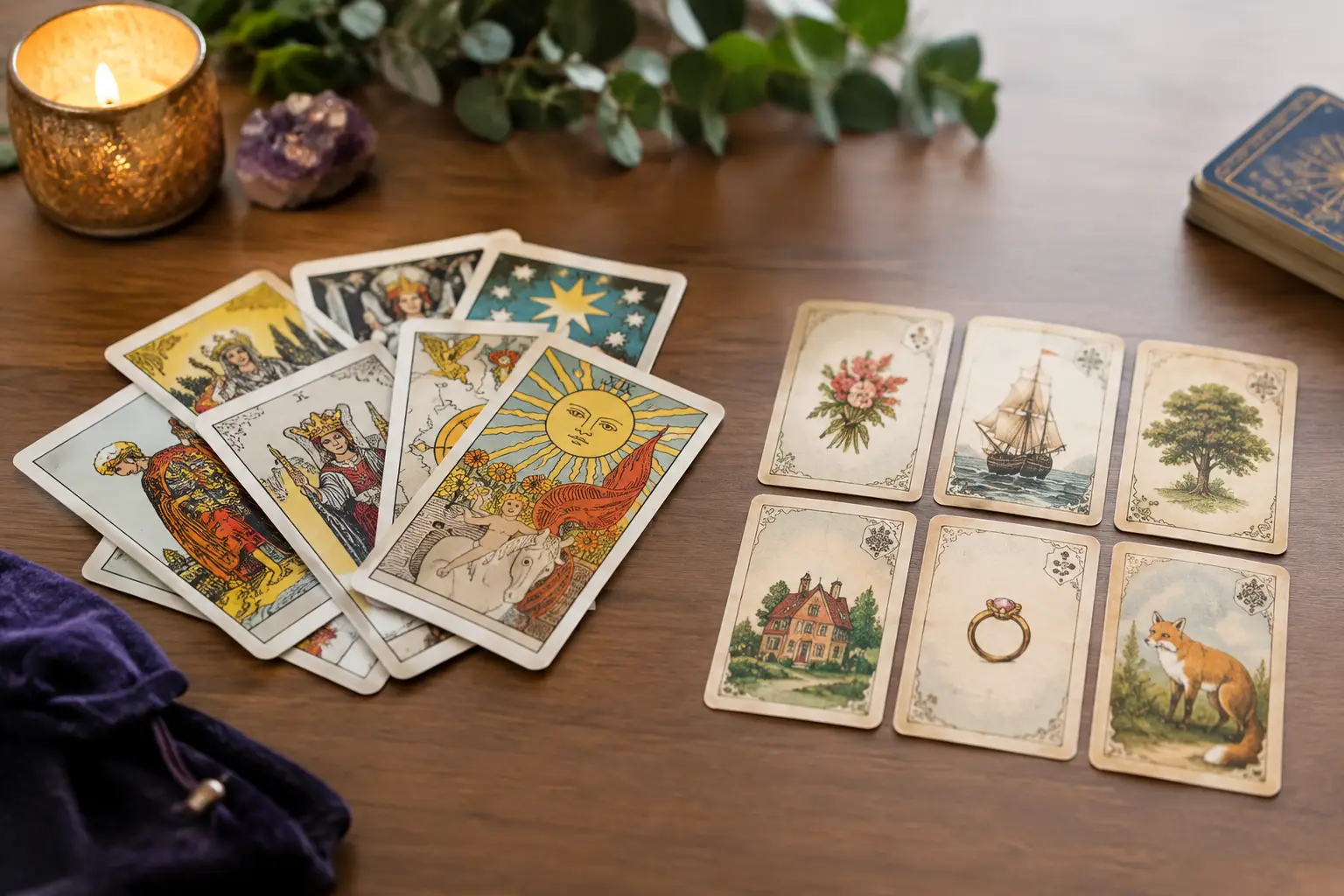
You have a question that will not leave you alone: is that relationship truly changing, should you accept the new role, or is the timing simply not right? When choosing between tarot versus Lenormand readings, the difference is not about which system is more powerful. It is about the kind of clarity you need right now. Tarot often gives language to your inner world, while Lenormand tends to bring the situation into sharp, practical focus.
Both can be deeply insightful in the hands of an intuitive reader. Yet they speak in different styles. Knowing the difference can help you arrive at your reading feeling more settled, ask a clearer question, and recognise the guidance that feels most relevant to your path.
Tarot Versus Lenormand Readings: The Core Difference
Tarot is a symbolic system with 78 cards. Its Major Arcana cards reflect significant life lessons and turning points, while the Minor Arcana explores the everyday landscape of emotions, thoughts, work, conflict and connection. A tarot reading can feel like sitting with the deeper story beneath your question. It may show what you are carrying, what is influencing another person, the pattern asking to be understood, and the energy surrounding possible choices.
Lenormand uses a compact deck of 36 straightforward symbols, such as the Rider, Heart, Key, Clouds, Ring and Anchor. Rather than interpreting one card in isolation, Lenormand cards are read in combinations, almost like a visual sentence. The Heart beside the Ring may speak clearly of a loving commitment. Clouds beside the Ring may point to uncertainty around an agreement or relationship. Context and card placement matter greatly.
Put simply, tarot asks, “What is happening within and around this experience?” Lenormand is more likely to ask, “What is happening, who is involved, and what may unfold next?” There is overlap, of course. A skilled reader may use either deck to explore love, career, family or life direction. The tone of the message is where the difference becomes most noticeable.
When Tarot May Be the Better Choice
Choose tarot when your question has emotional layers or when you want insight that supports reflection and personal growth. It can be especially comforting after heartbreak, during a major transition, or when you keep reaching the same crossroads and cannot understand why.
Perhaps you are wondering why you feel drawn to someone who is inconsistent. Tarot can explore the dynamic, your needs, fears, hopes and the lesson emerging through the connection. Rather than reducing the situation to a simple yes or no, it may reveal where your energy is best placed and what would help you move forward with greater self-trust.
Tarot is also useful when the question is broad. “What do I need to understand about my next chapter?” or “What energy should I bring to my work life?” gives the cards room to illuminate themes you may not have considered. Its imagery invites intuitive recognition. Sometimes a card does not predict an event so much as name a truth you already felt but had not been ready to say aloud.
That does not mean tarot cannot be practical. A spread can look at choices, obstacles, likely developments and supportive actions. It simply tends to place those practical details within a wider emotional or spiritual context.
Questions that suit tarot
Tarot often works beautifully for questions about healing, recurring patterns, personal purpose, confidence, emotional blocks and the deeper meaning of a decision. It can also be a supportive format if you are feeling vulnerable and need space to understand your feelings before deciding what comes next.
The trade-off is that tarot can feel less immediate if all you want is a crisp answer about a specific development. Its richness is a strength, but it may offer several layers to sit with rather than one direct statement.
When Lenormand May Be the Better Choice
Lenormand is often the preferred choice when the details matter. If you want to understand the movement around a conversation, job application, travel plan, financial matter or relationship development, its direct symbolic language can be remarkably useful.
Imagine asking about a job opportunity. A Lenormand reading may highlight news arriving soon, a helpful person involved in the process, paperwork that needs attention, or delays that require patience. In a relationship question, it may focus on communication, boundaries, commitment, distance or another outside influence. The cards build meaning together, which makes the reading feel grounded in the shape of the situation.
Lenormand is not cold or impersonal. It can reveal the warmth of a Heart, the devotion of a Dog, or the stability of an Anchor. But it is generally less interested in analysing every emotion behind the event. Its gift is clear observation. It can be a valuable choice when you feel stuck in overthinking and want to see the practical factors at play.
Questions that suit Lenormand
Lenormand can be especially helpful for questions such as: “What is likely to develop if I send this message?”, “What should I know about this work opportunity?”, “What is influencing the delay?” or “What is the next step in this connection?”
The trade-off is that its directness may feel brisk when you need emotional processing. If the real question beneath “Will they contact me?” is “Why does this situation hurt so much?”, tarot may provide more room for the answer your heart is actually seeking.
Timing, Prediction and Free Will
People often turn to cards because uncertainty can feel exhausting. Both tarot and Lenormand may offer insight into likely timing and future developments, but neither is a fixed script. Choices change, people change, circumstances shift, and new information can alter the direction of a situation.
Lenormand is often associated with concrete developments because its combinations can point to messages, meetings, contracts, travel or changes in circumstances. Tarot can also speak to timing, although it may emphasise readiness, momentum and inner alignment rather than a precise date.
A reading is most supportive when you use it as guidance, not as permission to hand over your power. If a message points towards an opportunity, you still decide whether it aligns with your values. If it highlights a challenge, you can meet that knowledge with preparation rather than fear. The purpose is not to make you dependent on certainty. It is to help you see your choices with more awareness and confidence.
How to Choose the Right Reading for Your Question
Start by noticing what you most need. If you need to understand your feelings, heal a pattern or explore the meaning of a major life phase, tarot may feel like the right companion. If you want clarity around events, communication, people or the next likely development, Lenormand may be the clearer fit.
You do not have to choose perfectly. A good reader can help shape a vague concern into a question that serves you, and some readers blend both systems when that approach suits the situation. Tarot may reveal the emotional truth of a relationship, while Lenormand may bring focus to the communication or practical circumstances surrounding it.
It also helps to be honest about what you are hoping to hear. If you are seeking reassurance, say so. If you want a direct reading, say that too. The more openly you share the heart of your question, the easier it is for the reading to meet you where you are.
Preparing for a More Meaningful Reading
You do not need a perfectly worded question or a special ritual before a reading. A quiet moment to breathe and name your intention is enough. Instead of asking a dozen questions at once, choose the one that feels most alive for you.
Try moving from a question that seeks absolute certainty to one that invites useful guidance. “Will everything work out?” may become “What do I need to know to make the best decision?” “Are they my person?” may become “What is the truth of this connection, and what supports my wellbeing?” These questions leave room for insight without asking the cards to carry the full weight of your future.
If you are unsure, a 24/7 phone reading can offer the ease of speaking with someone in the moment, while SMS or email formats can suit a question you would prefer to reflect on privately. At Soul 2 Path, reader profiles can also help you find someone whose approach feels right for the guidance you are seeking.
The best deck is the one that helps you hear yourself more clearly. Tarot may bring you back to the wisdom beneath your emotions. Lenormand may help you see the road ahead without fogging it with fear. Whichever you choose, let the reading be a steady pause – a chance to return to your own intuition and take the next step with a little more trust.