A recurring relationship pattern, a career decision that will not settle, or the sense that you are ready for a different chapter can make you ask a more personal question: why do I respond to life this way? An astrology birth chart offers a symbolic map for that question. It captures the positions of the planets at the time and place of your birth, then brings those placements together into a picture of your tendencies, needs and possible growth.
It is not a fixed script for your future. Your choices, circumstances and lived experience matter. But when you feel caught between your head and your heart, a birth chart can give language to patterns you already sense and help you meet the next decision with greater self-awareness.
What is an astrology birth chart?
Also called a natal chart, a birth chart is calculated from three details: your date of birth, your exact birth time and your birthplace. The time matters because it determines the rising sign and the placement of the houses, which move quickly across the horizon. Even a difference of 10 or 15 minutes can shift the finer details of a chart.
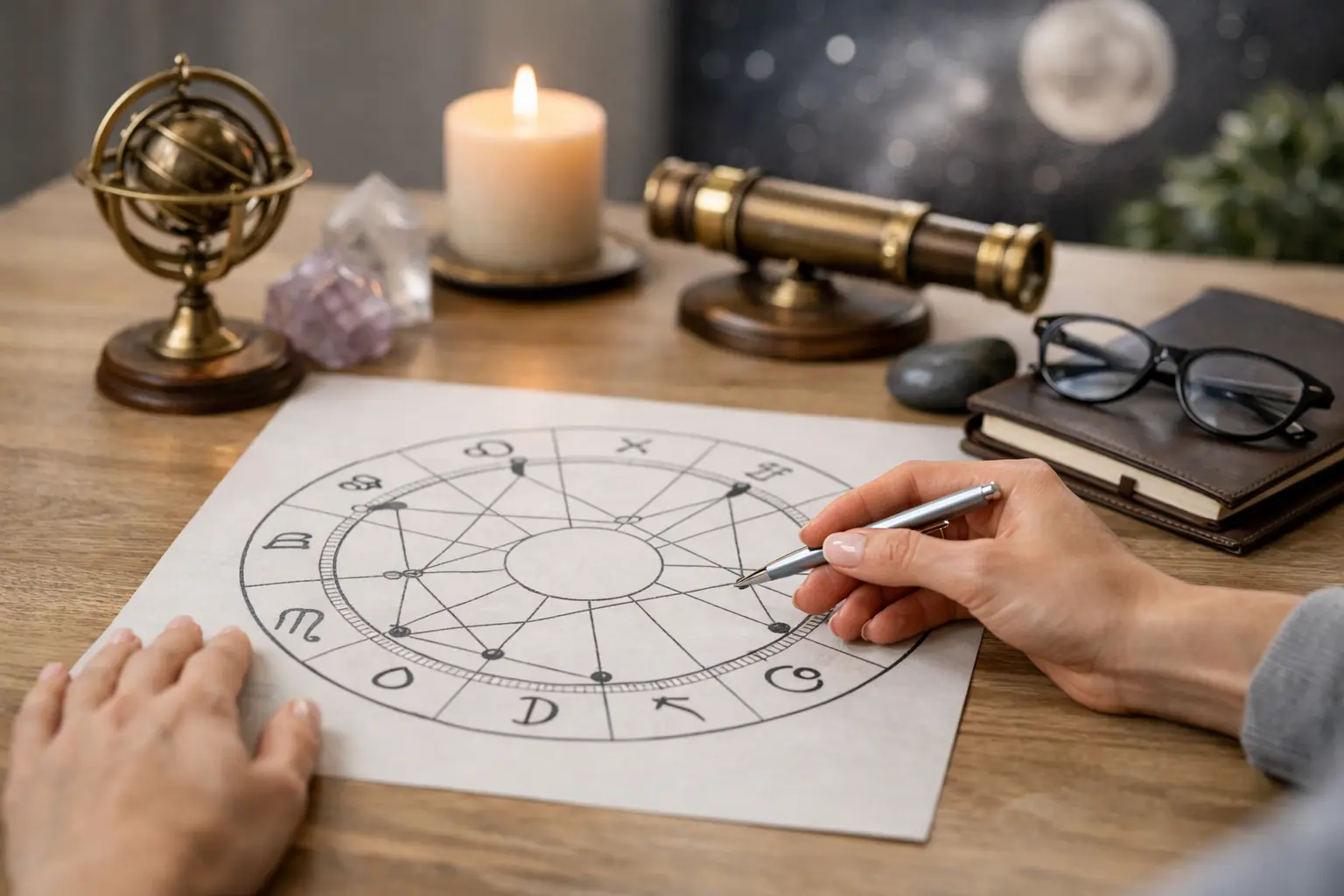
Think of it as a snapshot of the sky at your first breath. The Sun, Moon and planets are placed in zodiac signs and in twelve houses. Their angles to one another, known as aspects, add another layer. An astrologer reads these parts together rather than relying on one placement alone.
That is why a sun-sign horoscope can feel broadly familiar while a personalised chart feels more specific. Your Sun sign is meaningful, but it is only one voice in a much larger conversation.
The three placements most people notice first
Your Sun sign: your central sense of self
The Sun is often associated with identity, vitality, purpose and the qualities you are growing into. A Leo Sun, for example, may be drawn to creative self-expression or being seen for their contribution, while a Virgo Sun may find confidence through service, discernment and practical improvement.
This does not mean every Leo wants the spotlight or every Virgo is perfectly organised. The house placement, aspects and the rest of the chart shape how that solar energy is expressed. Astrology is most useful when it makes room for complexity.
Your Moon sign: your emotional needs
Your Moon sign speaks to instinctive reactions, emotional comfort and what helps you feel safe. It can be especially helpful when you are looking at relationship dynamics, family patterns or the way stress affects you.
Someone with a Moon in Cancer may need closeness, familiarity and a protected home base. A Moon in Aquarius may process feelings through perspective, friendship or space. Neither approach is better. Knowing your Moon can help you recognise what you need before you reach a point of overwhelm.
Your rising sign: how you meet the world
Your rising sign, or ascendant, is the sign on the eastern horizon when you were born. It is linked with first impressions, your outward approach and the way you naturally begin things. It also sets the layout of the twelve houses.
This is one reason accurate birth time is valuable. If you do not know it, you can still explore your planetary signs, but the house placements and rising sign should be treated with care. A chart reading can still be insightful, just less precise around life areas and timing.
The houses show where life is asking for attention
The twelve houses represent different areas of life. They give the planets a setting. A planet in a sign describes how an energy may operate; its house suggests where you are likely to encounter it.
The first house relates to identity and self-presentation. The fourth points towards home, family and inner foundations. The seventh brings focus to committed relationships, while the tenth is often connected with vocation, public life and ambition. Other houses explore money, communication, creativity, health, shared resources, beliefs, community and the private inner world.
For example, Venus in a chart can describe affection, values, pleasure and relating. Venus in the second house may bring attention to self-worth and material values, while Venus in the seventh may highlight the desire for harmony in partnership. The full interpretation depends on the sign, aspects and the person’s real-life context.
Planets and aspects add depth to your story
Each planet is traditionally associated with a different kind of energy. Mercury speaks to communication and thought patterns. Venus relates to love, connection and values. Mars shows drive, desire and how you take action. Jupiter is linked with growth and perspective, while Saturn can reveal responsibility, boundaries and lessons that ask for patience.
The outer planets move more slowly and often describe longer generational influences, yet their placement can feel deeply personal when they connect strongly with your Sun, Moon or rising sign.
Aspects are the relationships between planets. A flowing aspect may show an ability that comes naturally, though it can sometimes be taken for granted. A more challenging aspect can reveal friction, but it may also point to determination, maturity and a powerful area of development. Calling an aspect good or bad is usually too simple. Some of the chart’s most meaningful insights live in its tensions.
How to read your birth chart without getting lost
A chart can look intimidating at first: symbols, lines, degrees and a circle divided into twelve sections. Start with the big three – Sun, Moon and rising sign – then notice where Mercury, Venus and Mars sit. From there, look for repeating themes rather than trying to memorise every symbol in one sitting.
Ask practical questions as you go. Does your Moon placement describe how you recover after a difficult week? Does your Mercury sign reflect the way you communicate when you feel secure, or when you are under pressure? Does a strong tenth-house focus mirror your relationship with work, recognition or responsibility?
Keep what resonates, stay curious about what does not, and avoid using astrology as a reason to box yourself in. A chart can explain a tendency, but it does not remove your capacity to choose a different response. If you are navigating grief, anxiety, abuse or a serious mental health concern, spiritual insight works best alongside appropriate professional support.
When a personalised reading can help
Online chart generators are a useful starting point, especially when you want to confirm your placements. A personalised reading can be more helpful when several themes overlap or you want to explore a particular crossroads, such as a change in career, a relationship question or a period of personal transition.
The value is not in someone making every choice for you. A thoughtful reader helps you connect the symbols to your life, identify the questions beneath the question and see your options with clearer eyes. You may leave with reassurance, a fresh perspective or simply a better way to name what has been happening within you.
At Soul 2 Path, astrology can sit alongside psychic guidance, tarot or numerology when you want support that meets you where you are. Choose the format that feels right for you, whether that is a private phone conversation, an SMS exchange or time to reflect on an email reading.
Your chart is a starting point, not a verdict
The most supportive way to work with an astrology birth chart is to return to it as your life changes. A placement that felt confusing at 22 may make perfect sense at 35. A Saturn lesson that once felt heavy may later reveal the boundaries that helped you build a steadier life.
Let your chart encourage compassion rather than certainty. Notice the patterns, honour your intuition and give yourself permission to move forward in a way that feels aligned with who you are becoming.