You do not need to memorise every astrological symbol to begin understanding your birth chart. If you have ever looked at one and felt like you were staring at a cosmic wheel of tiny glyphs and intersecting lines, you are not alone. Learning how to read a natal chart starts with knowing what to look at first, what can wait, and how the different pieces speak to each other.
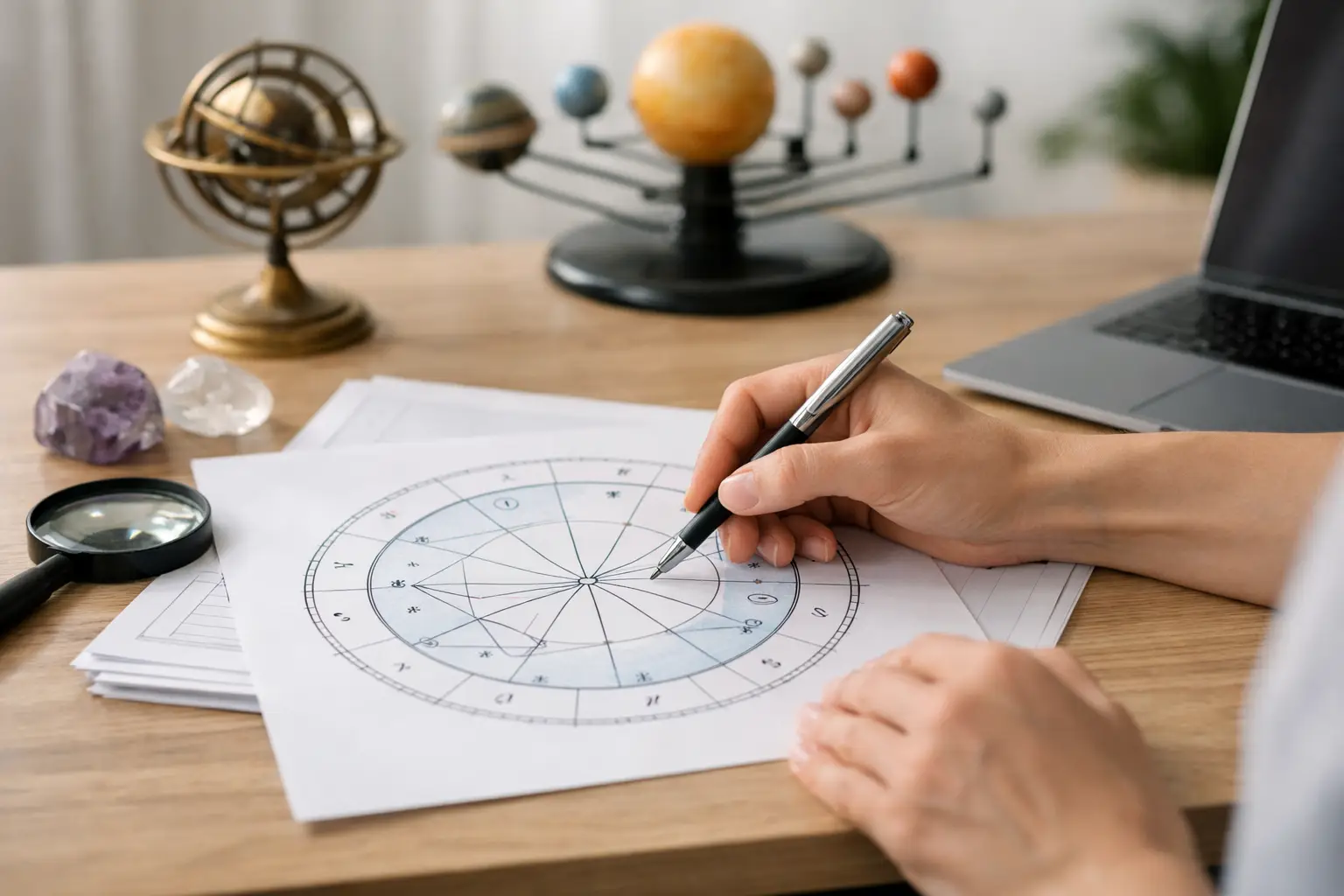
A natal chart is a snapshot of the sky at the exact moment you were born. It maps where the planets were, which zodiac signs they moved through, and which areas of life those energies land in. The chart does not tell you who you must be. It shows tendencies, strengths, patterns, tensions and opportunities, which is why so many people turn to astrology when they want clarity around relationships, purpose, timing and personal growth.
How to read a natal chart without getting overwhelmed
The biggest mistake beginners make is trying to interpret everything at once. A chart has layers. If you try to read all the planets, all the houses and every aspect in one go, it becomes noise. A calmer approach is to read the chart in stages.
Start with the big three – your Sun, Moon and Rising sign. These are often the clearest doorway into the chart because they describe your core identity, your emotional nature and the way you meet the world. From there, look at the personal planets, then the houses, and only then move into aspects and deeper patterns.
Think of it this way. The planets show what is happening. The signs show how it happens. The houses show where it happens. The aspects show how those parts of you interact, whether smoothly or with friction.
Start with the foundations
Before interpretation, make sure the birth details are right. A natal chart depends on your date, place and exact time of birth. Even a small time difference can shift the Rising sign and house placements, which changes the structure of the whole chart.
If your birth time is uncertain, you can still learn from the chart, but be careful with house interpretations and the Ascendant. In that case, the planetary signs may still be useful, but timing-based insights become less reliable.
The Sun, Moon and Rising
Your Sun sign is the part most people already know. It speaks to your basic life force, identity and conscious self. If your Sun is in Leo, for example, you may be drawn to creative self-expression, warmth and being seen for who you truly are.
Your Moon sign describes your emotional world, your instinctive reactions and what helps you feel safe. Someone with a Moon in Pisces may process feelings deeply, absorb the moods around them and need more solitude or spiritual connection to reset.
Your Rising sign, also called the Ascendant, shapes first impressions, your outer style and the lens through which you approach life. It also sets up the house system, which is why it matters so much. A Capricorn Rising may appear steady, self-controlled and practical, even if their Sun sign is much more spontaneous.
These three placements often explain why people do not fully relate to their Sun sign alone. You are not one note. You are a blend.
Understand the planets as different parts of you
Once you have the big three, move to the personal planets. Mercury shows how you think and communicate. Venus speaks to love, connection, values and pleasure. Mars shows drive, desire, anger and the way you take action.
If Mercury is in Gemini, the mind may move quickly and enjoy variety. If Venus is in Taurus, love may be expressed through loyalty, touch and consistency. If Mars is in Aries, there is often a direct, bold style of action.
The outer planets move more slowly and tend to speak to generational themes, though they still matter personally through their house placement and aspects. Jupiter expands what it touches and often shows confidence, growth and belief. Saturn brings structure, lessons and maturity. Uranus disrupts, Neptune softens boundaries, and Pluto transforms.
When reading, do not isolate a planet from the rest of the chart. Venus in Scorpio will not feel the same in every chart. Its expression changes depending on the house it sits in and the aspects it makes.
The signs describe style and expression
Each planet expresses itself through a zodiac sign. That sign colours the planet’s energy. This is where nuance matters.
For example, the Moon in Cancer and the Moon in Aquarius both describe emotional life, but in very different ways. Cancer may seek closeness, familiarity and emotional bonding. Aquarius may need space, objectivity and emotional independence. Neither is better. They simply process life differently.
This is one reason astrology can feel validating. It gives language to patterns you may have felt for years but never quite named.
The houses show where life themes play out
If planets are the actors and signs are the costumes, houses are the stage. The houses represent different areas of life, such as identity, money, communication, home, romance, work and relationships.
A Venus in the seventh house often points to relationships being central to growth and fulfilment. A Mars in the tenth house can suggest ambition, visibility and a strong drive around career. A Moon in the fourth house may show deep ties to home, family history or the need for a secure private world.
Beginners often find houses easier once they stop trying to learn all twelve in one sitting. Read them slowly and connect them to real life. Ask yourself where this planet tends to show up for me. What part of life carries this energy most clearly?
How to read a natal chart through aspects
Aspects are the angles planets make to one another. They tell you whether different parts of your personality work together easily, challenge one another, or create a push-pull dynamic.
A trine usually shows flow. A square tends to bring tension and growth through effort. An opposition can feel like a balancing act between two competing needs. A conjunction blends energies together, sometimes so closely that they become hard to separate.
For example, Moon trine Venus can suggest emotional warmth and an easy capacity for affection. Mars square Saturn may feel more frustrating at first, as drive meets resistance, but it can also build serious discipline over time. This is where astrology becomes more than a list of traits. It shows your inner dynamics.
It also shows why simple Sun sign content can only go so far. Two people with the same Sun sign may live that energy very differently depending on their aspects.
Look for patterns, not just placements
A chart becomes more meaningful when you notice repetition. Is there a strong emphasis on one element, like fire or water? Are several planets grouped in one house? Do certain signs repeat? Is Saturn making major contacts that suggest lessons around responsibility or self-trust?
These patterns often point to the themes that matter most. A chart with many planets in earth signs may approach life through practicality, patience and tangible results. A chart full of mutable energy may adapt quickly but struggle with consistency. A strong eighth house emphasis may point to transformation, intimacy, trust and emotional depth being major life teachers.
This pattern-based reading is often where people move from curiosity into real insight. Instead of collecting disconnected meanings, you start to hear the chart’s main message.
Keep interpretation grounded
Astrology works best when it is used with honesty. Not every placement will feel obvious right away. Some show up more strongly with age. Some are expressed privately. Others become clearer in relationships or under stress.
That is why context matters. A Saturn placement can feel heavy in one period of life and deeply stabilising in another. A Neptune influence can be intuitive and imaginative, but if it is not grounded, it may also bring confusion or idealisation. It depends on the whole chart and the person’s current season of life.
If you are reading your own chart, be gentle with yourself. Avoid turning difficult aspects into fixed labels. A square is not a flaw. A Saturn lesson is not a punishment. These parts of the chart often point to the areas where the deepest growth becomes possible.
When a professional reading helps
Self-study is powerful, but there comes a point where an experienced reader can help you see what you might miss. This is especially true if you are exploring relationship patterns, life direction, repeating blocks or periods of major change.
A professional reading can translate the symbols into practical guidance, helping you understand not just what is in the chart, but how to work with it. For many people, that is where astrology becomes less abstract and more personally supportive. If you want insight that feels both intuitive and clear, a trusted spiritual platform like Soul 2 Path can help bridge that gap.
A simple way to practise
Choose one planet at a time. Read its sign, then its house, then any major aspects. Write down what feels accurate, what surprises you and what shows up in your real life. This slower method builds confidence far more quickly than trying to decode the entire chart in one sitting.
You are not meant to read a natal chart perfectly on day one. You are meant to build a relationship with it. The more patiently you return to it, the more it starts to feel less like a puzzle and more like a mirror.