You may know your star sign, yet still feel that its description only captures part of who you are. That is because your Sun sign is one thread in a much larger pattern. This guide to astrology birth charts helps you understand that pattern, so you can reflect on your relationships, strengths, emotional needs and life direction with greater clarity.
A birth chart, also called a natal chart, is a symbolic map of the sky at the precise moment and place you were born. It does not tell you that one outcome is guaranteed or remove your power to choose. Instead, it offers a language for recognising your natural tendencies, the lessons that may repeat, and the inner resources you can call on when life feels uncertain.
What you need before reading a birth chart
Accuracy begins with your birth details. You will need your date of birth, birthplace and, ideally, your exact time of birth. The time matters because it determines your rising sign and the placement of the twelve houses, which show the areas of life where different energies are most likely to be felt.
If you do not know your birth time, check a birth certificate or ask a parent or family member. A chart can still offer useful insight without it, but the rising sign, house placements and some timing techniques become less reliable. It is better to treat an unknown time honestly than to build meaning around a guess.
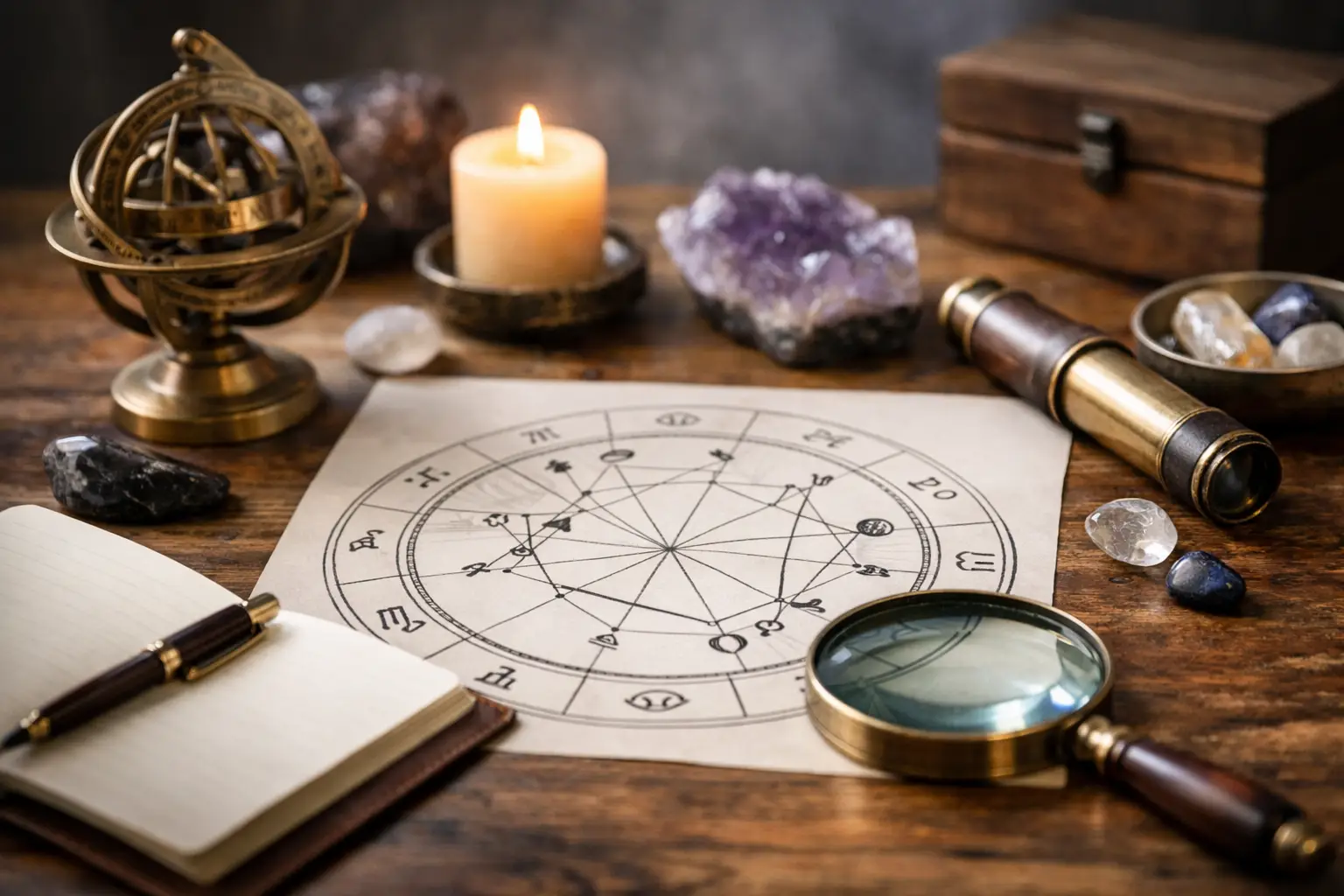
Once you have your details, you will see a circular chart filled with symbols, lines and segments. It can look busy at first. Start with the major placements rather than trying to interpret every detail at once.
Your astrology birth chart at a glance
The three placements most people begin with are known as the Big Three: your Sun, Moon and rising sign. Together, they offer a more rounded picture than a horoscope based on your Sun sign alone.
Your Sun sign: your core direction
Your Sun sign describes a central part of your identity. It reflects the qualities you are learning to express with confidence, the ways you seek purpose, and what helps you feel most like yourself. A Leo Sun may be drawn towards wholehearted self-expression, for example, while a Virgo Sun may find meaning through discernment, service and practical improvement.
Your Sun sign is not a box. Someone with a quiet nature can still have a Leo Sun, just as a creative person may have an earth sign Sun. The full chart explains how and where that solar energy is expressed.
Your Moon sign: your emotional world
The Moon speaks to feelings, instincts, comfort and the needs that arise when you are under pressure. It can reveal what makes you feel safe, how you process change, and the kind of emotional care you may need from yourself and others.
If your Sun sign reflects how you grow into yourself, your Moon sign often shows what you do without thinking. Understanding it can be especially helpful when you are navigating heartbreak, family dynamics or a period of emotional uncertainty.
Your rising sign: your approach to life
Your rising sign, or ascendant, is the sign that was on the eastern horizon when you were born. It shapes your first impression, but it is more than appearance. It reflects how you meet new experiences, the pace at which you move through life and the lens through which you interpret the world.
The rising sign also sets the layout of your houses. This is why an accurate birth time adds so much depth to a chart reading.
The planets show different parts of you
Each planet represents a distinct inner function. The sign a planet sits in describes its style, while the house tells you where in life that energy may be most active.
Mercury relates to communication, thought patterns and learning. Venus speaks to love, values, pleasure and how you give or receive affection. Mars reflects drive, desire, boundaries and the way you take action. Jupiter points towards growth, faith and opportunity, while Saturn shows responsibility, structure and the areas where patience can develop lasting strength.
The outer planets – Uranus, Neptune and Pluto – move slowly and are shared by many people of the same generation. Their house placements and connections to your personal planets make their influence more individual. They can point to awakening, imagination, transformation and the deeper changes that reshape your path over time.
The twelve houses bring the chart into daily life
If planets are the actors and signs are their style, houses are the settings where the story unfolds. The first house is connected with identity and self-presentation. The second concerns money, possessions, self-worth and personal resources. The third relates to communication, learning and your immediate environment.
The fourth house speaks to home, family and foundations, while the fifth brings attention to creativity, pleasure, romance and self-expression. The sixth is associated with routines, wellbeing and daily work. The seventh focuses on close partnerships, and the eighth explores intimacy, shared resources, trust and emotional transformation.
The ninth house is linked with travel, beliefs, study and the search for wider meaning. The tenth concerns career, public direction and reputation. The eleventh covers friendships, communities and long-term hopes, while the twelfth can reveal your private inner world, spiritual life and patterns that need gentle awareness.
A planet in a house is not a prediction. Venus in the seventh house does not promise an effortless relationship, for instance. It may suggest that partnership, fairness and connection are significant themes, but the quality of those experiences also depends on the wider chart and your choices.
Aspects reveal how your energies work together
The lines in the centre of a birth chart are called aspects. They describe the relationships between planets. Some aspects feel natural, while others create friction that asks for conscious growth.
A conjunction blends two planetary energies. A trine or sextile often shows an easier flow, such as a natural talent or supportive outlook. A square can create tension, while an opposition highlights two needs that may need balancing. Neither is simply good or bad. A challenging Mars-Saturn aspect, for example, can feel frustrating when you want to act but meet delays. With maturity, it can also support discipline, resilience and carefully directed ambition.
This is one reason a thoughtful interpretation matters. Your chart is not a scorecard of favourable and unfavourable placements. It is a living pattern, and each part gains meaning through the whole.
How to use this guide to astrology birth charts
Begin with your Big Three, then look at the house placements of your Sun, Moon and rising sign ruler. Notice which themes feel familiar, but leave room for what may become clearer over time. A birth chart often names experiences you have sensed but not yet had words for.
Next, consider Mercury, Venus and Mars. These can be particularly useful when you want insight into how you communicate, what you need in love, and how you handle conflict or pursue what matters to you. If you are making a major decision, look for patterns rather than searching for a single placement to give you permission or a final answer.
It also helps to keep a journal. Write down the placements that resonate, the questions they raise and the situations where you notice those qualities showing up. Astrology is most supportive when it encourages self-awareness, not when it makes you feel fixed or powerless.
When personalised guidance can help
Reading your own chart can be meaningful, but it is normal to feel unsure about conflicting placements or complex aspects. You might have an outgoing rising sign with a private Moon, or a strong desire for security alongside a chart that craves freedom. These are not contradictions to solve. They are different parts of you asking to be understood.
A personalised astrology reading can help you bring those pieces together, particularly when you are considering a relationship, career change, move, or a fresh chapter. At Soul 2 Path, guidance is available in a private format that lets you ask the questions that matter to your own circumstances, rather than relying on a general forecast.
Your birth chart is not a verdict on your future. Let it be a compassionate mirror: one that helps you recognise your patterns, honour your intuition and choose your next step with more confidence.