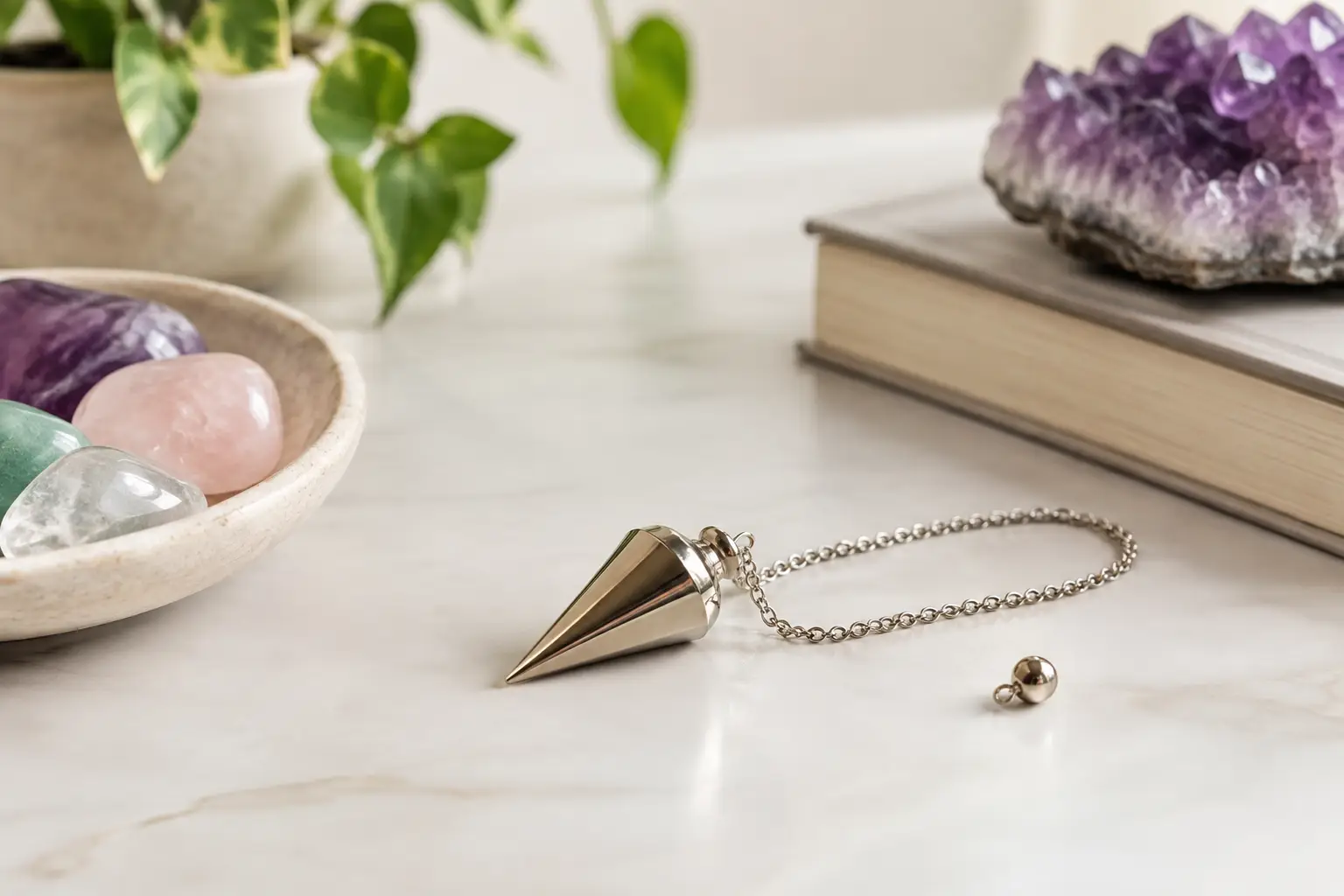
A pendulum reading can feel beautifully simple: ask a question, watch the movement, listen inward. Yet the best pendulum tools do more than give you something to hold. They create a calm, repeatable practice where your question is clear, your body is settled and your interpretation stays grounded.
Whether you are choosing a first pendulum or refining a ritual you already love, focus less on finding a supposedly perfect crystal and more on choosing tools that help you feel centred, present and honest with yourself. A pendulum is a form of intuitive guidance, not a substitute for professional medical, financial or legal advice. Its real value is often in the pause it creates before you make your next choice.
What makes the best pendulum tools?
The right setup should feel easy to use, not overly complicated. A pendulum that is too light can be difficult to read, while one that is overly large or heavily decorated may feel awkward in your hand. A simple point or teardrop shape on a secure chain is often an excellent place to begin because the movement is visible and consistent.
Material matters mostly because of your personal connection to it. Clear quartz is a popular all-purpose choice, amethyst may appeal when you want a quieter, reflective practice, and rose quartz can feel supportive for relationship-focused questions. Brass, wood and glass pendulums are equally valid choices. If a tool feels comfortable, balanced and suited to your intention, it is more likely to become part of a practice you return to.
Price is not a measure of intuitive ability. A modest pendulum used with care can be more useful than an expensive piece that leaves you worried about getting it wrong. Look for sound construction, a chain that does not tangle easily and a weight that can swing freely without pulling at your fingers.
A simple pendulum and chain
For most people, this is the essential tool. Hold the end of the chain between your thumb and forefinger, leaving enough length for the weight to move without touching your palm. A chain of around 15 to 20 centimetres gives many beginners a manageable starting point, although there is no single correct length.
Before buying, notice whether the pendant has a clear centre point. Pointed pendulums make directional movement easier to observe, while round or irregular pieces can still work but may be less obvious when you are learning. If you are ordering online, choose a seller that shows the size and fastening clearly rather than relying on polished photographs alone.
Crystal, metal or wood?
Choose a crystal pendulum if the meaning of stones forms part of your spiritual practice. Choose metal if you would like a steady weight and durable everyday option. Choose wood if you prefer a lighter, natural feel or want to keep the tool away from moisture-sensitive materials. There is no universal energetic ranking here. The best choice is the one you can hold comfortably and use without second-guessing every movement.
A yes-and-no chart for consistent answers
A pendulum chart is one of the most helpful additions for new users. It gives the pendulum a visual structure, typically with sections for yes, no, maybe and unclear. Some charts also include letters, numbers, timing prompts or emotional themes, but these can become overwhelming before you have built confidence with straightforward questions.
Begin with a basic chart or a sheet of paper marked with your own directions. First establish what yes, no and unclear look like for you. Hold the pendulum still and ask, “Show me yes.” Then ask for no, followed by unclear or not now. The movements may be circular, side to side or forward and back. Your pattern can differ from somebody else’s, so there is no need to force it to match a guidebook.
Keep your early questions specific. “Would it support my wellbeing to rest tonight?” is clearer than “What should I do with my life?” A chart helps you stay with the question in front of you instead of searching for a dramatic answer.
A journal that keeps your practice honest
Of all the pendulum tools available, a journal may be the one that brings the most clarity over time. Write down the date, your question, the answer you received and what later unfolded. You may begin to notice that your clearest sessions happen when you are rested, or that relationship questions become muddled when you are feeling anxious and hoping for one particular outcome.
This record is not about proving every answer right or wrong. It is about recognising your patterns. A journal can reveal when a pendulum is helping you name something you already know and when it may be wiser to pause, gather practical information or speak with someone you trust.
A notes app on your mobile is perfectly suitable, particularly if you use intuitive tools while travelling or between busy commitments. A handwritten journal can feel more ritualistic, but convenience often makes a practice more sustainable.
Grounding tools for calmer readings
Pendulum work is most useful when you approach it from a settled place. You do not need an elaborate altar, but a few grounding supports can make a meaningful difference. A timer helps keep a session contained, especially if you tend to keep asking the same question. A glass of water, a few slow breaths, a quiet playlist or a favourite candle can signal that you are stepping away from distraction.
If you use candles, keep fire safety practical. Place them on a stable surface, away from curtains, pets and loose paper, and never leave them unattended. The ritual should help you feel safe, not create another thing to worry about.
Some people also like to cleanse their pendulum between readings with smoke, sound, moonlight or a gentle wipe with a soft cloth. Treat cleansing as an intention-setting practice rather than a rule you must perform perfectly. Check the care needs of your material first, as some crystals can fade in direct sunlight or be damaged by water and salt.
When digital pendulum tools are useful
Digital pendulum tools, such as interactive yes-or-no prompts and virtual charts, can be a helpful introduction when you are curious but not ready to purchase a physical pendulum. They are also handy when you want a quick moment of reflection on your mobile.
Their limitation is that they remove the tactile experience of holding a pendulum and noticing your own stillness, tension or expectation. For some people, that physical ritual is the point. For others, a digital format feels more private and accessible. It depends on whether you are seeking a spiritual routine, a prompt for reflection or both.
Use any digital tool as a doorway into your own awareness. Read the result, then ask yourself what reaction it brought up. Relief, resistance or disappointment can each tell you something worth exploring.
How to use pendulum tools without losing perspective
The most supportive pendulum practice is not one that hands over every decision. It is one that helps you slow down long enough to hear your own inner response. Avoid asking the same question repeatedly until you receive the answer you want. If the movement is weak, contradictory or unclear, take that as permission to step back rather than push harder.
It can also help to set boundaries around the questions you ask. Use your pendulum for reflection on personal choices, emotional check-ins and intention setting. For urgent health concerns, safety issues, legal matters or major financial decisions, turn first to qualified professional advice and trusted real-world information.
For deeper questions about love, timing or the direction you are taking, a conversation can sometimes offer more nuance than a yes-or-no answer. Soul 2 Path offers private psychic readings by phone, SMS and email when you would like personalised guidance alongside your own intuitive practice.
Your pendulum does not need to be rare, expensive or surrounded by complicated ritual to be meaningful. Choose a tool that feels balanced in your hand, ask with an open mind and give yourself enough quiet to recognise the wisdom that is already asking to be heard.