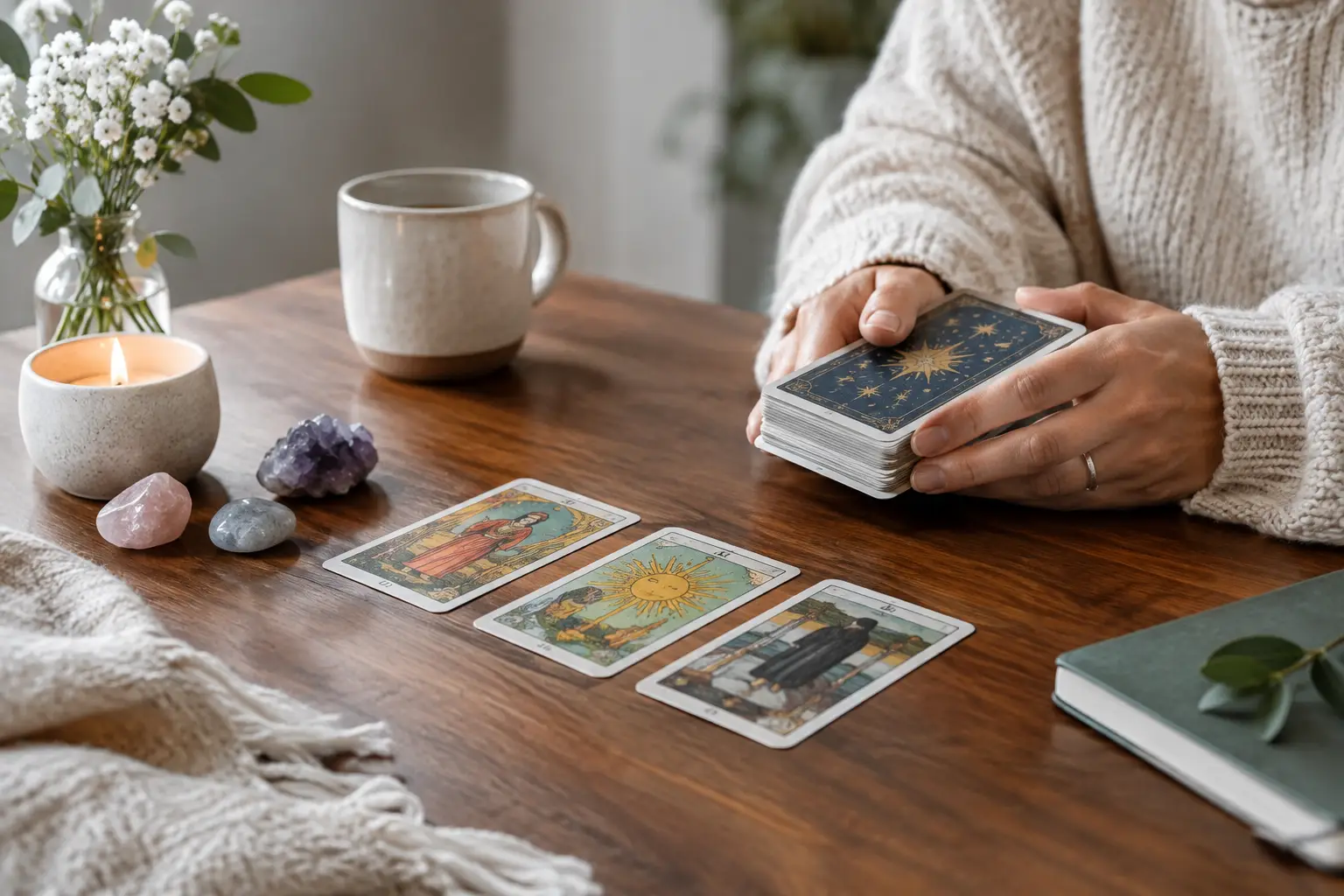
Grief can arrive loudly, or it can sit quietly beside you while life keeps asking for ordinary things: a reply to a message, a trip to the shops, another morning. Tarot for grief support is not about rushing you towards an answer or asking you to “move on”. It can create a private, gentle pause in which you can acknowledge what has changed, listen to what your heart needs, and take the next small step in your own time.
For many people, loss brings questions that do not have neat resolutions. You may miss someone deeply, feel angry at how things unfolded, or be surprised by a sense of numbness. You may be grieving a person, a relationship, a pregnancy, a pet, a home, your health, or a version of the future you expected. Tarot cannot remove that pain. What it can offer is a symbolic language for meeting it with honesty and compassion.
What tarot can offer during grief
A tarot reading works best in grief when it is treated as reflective guidance, not a prediction about whether your pain will end on a particular date. The images on the cards can give shape to feelings that are hard to name. A card such as the Five of Cups may speak to sadness and what feels absent. The Hermit can reflect a need for solitude and inner listening. The Star may gently point towards hope, healing and the small signs of life that remain.
The meaning does not need to be fixed. One person might see the Three of Swords and feel recognised in their heartbreak. Another may see the same card as permission to stop pretending they are fine. Your response matters as much as the traditional card meaning. The reading is a conversation with your inner world, not a test you need to get right.
This is particularly useful when grief feels confusing. Loss is rarely one emotion. Love, relief, regret, guilt, resentment and gratitude can exist side by side. A thoughtful reading makes room for those contradictions rather than judging them. You do not need to make your grief more spiritual, more graceful or more productive for it to be valid.
Tarot for grief support: questions that hold you gently
The question you bring to the cards shapes the experience. During a raw period, future-focused questions can sometimes feel too heavy. Rather than asking, “When will I be over this?”, choose a question that supports the present moment.
You might ask, “What feeling needs my kindness today?” or “What would help me feel supported this week?” If you are carrying regret, try, “What can I understand with more compassion?” When a significant date is approaching, a useful prompt may be, “How can I care for myself as this day arrives?”
These questions do not demand certainty. They help you notice your needs. Perhaps the cards point to rest, reaching out, making a memorial ritual, setting a boundary, or returning to a routine that gives you steadiness. The value is not in being told exactly what to do. It is in recognising what resonates and giving yourself permission to act on it.
Be cautious with questions that ask tarot to prove contact with someone who has died or to deliver definitive messages on their behalf. Some readers and clients experience spiritual connection as meaningful comfort, while others find it emotionally overwhelming. In either case, a caring reading should avoid certainty, fear or pressure. The focus should remain on your wellbeing, your memories and the support you need here and now.
A simple spread for difficult days
When your energy is low, one card may be enough. Pull a card and ask, “What can support me today?” Sit with the image for a few minutes before reaching for a guidebook. Notice the first detail that catches your attention. Is it a colour, a face, a landscape, an object, or the feeling in your body?
If you would like a little more structure, use three cards: what I am carrying, what I need to honour, and one gentle support for today. Keep the final position deliberately small. Grief is not a problem to solve in a single sitting, and a reading should not leave you feeling responsible for transforming everything at once.
Write down a few words after your reading. Over time, a tarot journal can become a record of how you have moved through different seasons of loss. You may notice recurring cards, changing interpretations, or moments when you were kinder to yourself than you realised. There is no need to read every day. Sometimes choosing not to draw a card is the most intuitive choice of all.
Creating a safe space for your reading
A grief reading deserves a little care around it. Choose a time when you are not about to rush into work, collect the kids or head out the door. Make a cup of tea, place a photo or meaningful object nearby if that feels comforting, and keep tissues within reach. Small rituals can signal to your nervous system that it is safe to slow down.
Set a clear intention before shuffling. It could be as simple as, “I am here to meet myself with kindness.” If a card feels confronting, you do not have to push through. Put the deck down, take a few slow breaths, and return another day. Tarot should be an invitation, never an emotional ambush.
It can also help to plan what happens after the reading. You might go for a walk, sit in the garden, call a trusted mate, listen to calming music, or make something nourishing to eat. Grounding matters because meaningful reflection can stir deep feelings. Let the reading be one part of your support, not the only place you hold your grief.
When a live tarot reading may help
Reading for yourself can be comforting, but it is not always easy to see clearly when emotions are close to the surface. A compassionate tarot reader can hold a calm, non-judgemental space and offer a different perspective on the cards. This may be especially helpful if you feel stuck in guilt, overwhelmed by decisions after a loss, or unsure how to reconnect with daily life.
Choose a reader whose approach feels respectful and grounded. A good reader will not make frightening claims, tell you to cut off loved ones, or promise to remove your grief. They will leave room for your choices and encourage you to trust your own inner knowing. At Soul 2 Path, a private mobile, SMS or email reading can suit people who want reflective support in a format that feels comfortable, with reader profiles helping you choose the right fit.
A live reading is not the same as bereavement counselling or mental health care. If grief is making it difficult to function, if you feel unsafe, or if you are having thoughts of harming yourself, please reach out to immediate professional support. In Australia, call 000 in an emergency, or contact Lifeline on 13 11 14 for crisis support. Tarot can sit alongside practical and professional care, but it should never replace it.
Let the cards meet you where you are
There is no correct timeline for grief, and there is no requirement to find a lesson in what happened. Some days, tarot may bring a moment of peace. On others, the kindest thing may be to leave the deck in its box and simply rest. Both choices can be part of caring for yourself.
If you do draw a card today, let it be a small companion rather than a command. Take what feels true, leave what does not, and remember that love and loss can continue to live together – one breath, one memory and one gentle day at a time.