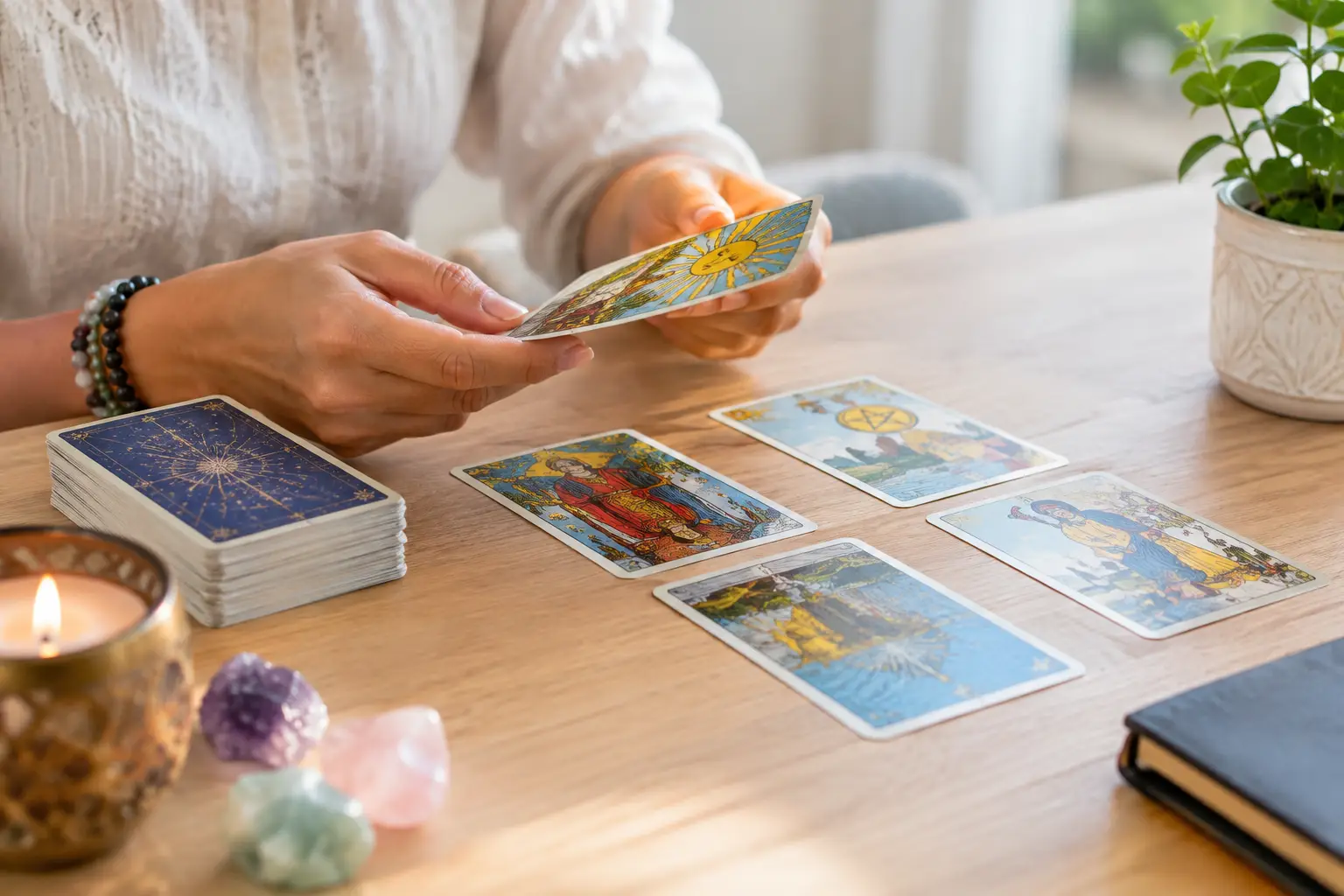
You shuffle carefully, ask a fresh question, and there it is again: the same card you pulled last week. Perhaps it is the Two of Cups while you are weighing up a relationship, the Tower during a major life change, or the Hermit when you have been craving space. If you are wondering why tarot cards repeat, you are not alone. Recurring cards can feel striking because they often arrive when a theme still needs your attention.
A repeated tarot card is not a warning that you have done something wrong, nor is it a fixed prediction you cannot change. Tarot is most useful as a reflective tool. It can highlight the patterns, emotions, choices and possibilities already moving through your life, so you can respond with greater awareness.
Why Tarot Cards Repeat in a Reading
Tarot cards may repeat because the heart of the matter has not shifted yet. You might be asking different questions on the surface – about whether to call someone, accept a role, move house or wait – while the deeper question remains the same. Are you trusting yourself? Are you holding a healthy boundary? Are you ready to release what no longer fits?
A recurring card can bring that underlying theme back into focus. The card is not necessarily insisting that one specific event will happen. Rather, it may be asking you to look more closely at the energy surrounding your choices.
For example, the Eight of Swords can reappear when you feel stuck, even if the details of the situation have changed. Its message may be less about being trapped by external circumstances and more about noticing the beliefs, fears or assumptions limiting your next step. Repeated appearances invite a more honest conversation with yourself.
There is also a practical explanation. Tarot contains a limited set of cards, and chance is part of any shuffle. A card repeating once or twice is completely normal. What gives repetition meaning is not simply the fact that it happened, but the context: your question, your emotional response, the cards around it and what is unfolding in your life.
The Repeating Card May Be Asking for Action
Sometimes we understand a card intellectually but have not acted on its guidance. This is where repetition can feel especially persistent.
The Queen of Swords may keep appearing when you know a conversation needs to happen, but you are avoiding it to keep the peace. The Four of Pentacles may return when you are holding tightly to money, security or an old identity because letting go feels risky. The Death card can surface repeatedly during a transition, reminding you that an ending is part of making room for a more aligned beginning.
In these moments, ask yourself: what have I already recognised, but not yet addressed? The answer does not need to lead to a dramatic decision. Action could mean setting aside time to rest, writing down a boundary, gathering more information or admitting what you truly want.
Tarot guidance works best when it supports your agency. You remain the person making decisions, setting the pace and choosing what feels right for your circumstances.
Upright and Reversed Cards Can Change the Message
If you use reversed cards, pay attention to whether the card repeats in the same position. An upright card may point to an energy you can express openly, while a reversed card might suggest an inner block, delay or more private process.
For instance, the upright Ace of Wands can speak of inspiration and a new spark. Reversed, it may reflect uncertainty about how to begin or energy that is being held back. Neither position is automatically good or bad. They simply offer different angles on the same archetype.
If a card appears upright one time and reversed the next, the message may be evolving. You may have moved from recognising an issue to working through it, or from feeling blocked to seeing a possible way forward.
Look Beyond the Card’s Traditional Meaning
A tarot card has a traditional symbolism, but your relationship with it matters too. The Six of Cups can be connected with nostalgia, childhood, memory and emotional gentleness. Yet if it repeats after a difficult break-up, it may bring up a very personal question: are you remembering the relationship as it truly was, or only as you wish it had been?
Notice your first reaction before reaching for a guidebook. Relief, resistance, sadness and frustration can all be useful clues. A card that annoys you may be touching a truth you are not quite ready to face. A card that comforts you may show the inner resource you need to lean on.
It can help to write down the date, your question, the card position and a few words about what was happening at the time. After several readings, patterns often become clearer. You may find that the same card appears around similar people, decisions or emotional states.
When Repeated Tarot Cards Mean You Need Space
There is a point where repeated readings on the same question stop providing clarity and start increasing anxiety. If you pull cards every day asking whether a particular person will return, whether an employer will choose you, or whether a decision is perfect, the repetition may be reflecting your need for reassurance more than offering new information.
That does not make your feelings invalid. Uncertainty can be exhausting, especially when your heart is involved. But a pause can be more supportive than another shuffle. Give the message time to settle, then return to tarot with a question that centres your own power.
Instead of asking, “Will they contact me?”, try asking, “What do I need to understand about this connection?” Instead of, “Will I get the job?”, ask, “What can help me show up confidently in this opportunity?” These questions create room for insight and practical movement.
How to Work With a Recurring Card
When the same card keeps appearing, begin by narrowing the focus. Consider what area of life it seems connected to: love, work, family, wellbeing, confidence or a choice that has been sitting heavily with you.
Then sit with the card without demanding an immediate answer. Look at its imagery. What detail catches your attention? What feels familiar? Which part makes you uncomfortable? Your intuition may notice something different each time, particularly as your situation changes.
You can also pull one clarifying card, rather than laying out a large spread. Ask what the recurring card wants you to acknowledge, what practical step supports you now, or what lesson is ready to be integrated. Keep the question open and grounded.
If the message feels emotionally charged or confusing, speaking with an experienced reader can offer a steadier perspective. A good reading does not take your choices away from you. It helps you explore the symbols, see your situation from another angle and move forward with more confidence.
Common Repeating Cards and Their Themes
Certain cards are often memorable when they return because their archetypes are strong. The Lovers may revisit questions about values, emotional honesty and meaningful choices, not only romance. The Wheel of Fortune can appear during changes in timing or circumstances, encouraging flexibility when life is moving beyond your usual control.
The High Priestess often asks for patience and deeper listening. The Chariot may encourage direction and self-discipline. The Devil can invite an honest look at attachments, fear or habits that are keeping you smaller than you need to be. None of these cards should be read in isolation or as a reason to panic.
The surrounding cards and your real-life circumstances always matter. A Tower beside the Star can feel very different from a Tower beside the Ten of Swords. One may speak to clearing the way for healing, while the other could acknowledge a difficult ending that needs compassion and support.
A repeated tarot card is not there to rush you. It may simply be returning like a familiar voice, asking you to pause, listen and choose your next step with care.